 Goldendoodle
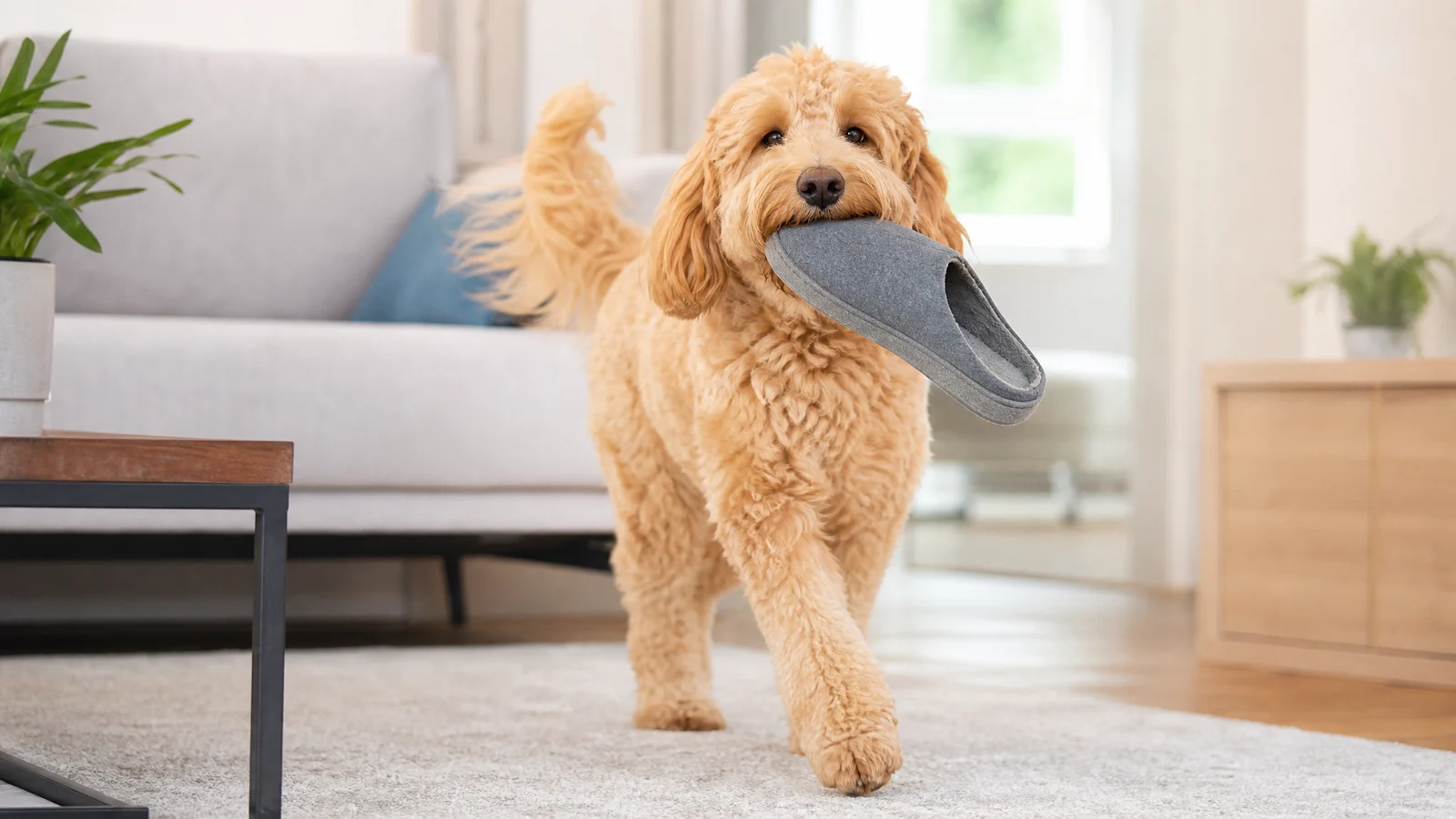
Many Goldendoodle behavior problems are strongest in a young, energetic dog and ease as the drives behind them are channeled. The first question owners ask is whether their dog will simply grow out of it. Often they do, but mostly because someone gave that energy a useful place to go.
The reason sits in the family tree. Golden Retrievers and Poodles were both developed as hunting dogs, and the Poodle's impulse is to retrieve. An eager dog with a thin daily routine fills the gap with mouthing, jumping and restlessness, while the same traits in a busy dog make a quick-learning partner.
In this article, we'll go through what carrying, greeting, barking, digging and chewing each reveal about those drives, and a reward-based fix for every one. We have trained and studied this breed for many years, and we know individual dogs vary.
Retriever Drives Behind Goldendoodle Behavior Problems
A drive is an inherited urge toward a certain kind of activity, one that feels rewarding in itself. Both Goldendoodle parents carry strong ones. The first Lord Tweedmouth developed the Golden Retriever in the Scottish Highlands as an ideal gundog for his Guisachan estate, and the Poodle was also a hunting dog with an impulse to retrieve and a name as an excellent water-retriever.
The breed ratings show how much fuel comes with that history. Energy is rated 3 of 5 for the Golden and 4 for the Poodle, while mental stimulation needs are rated 4 and 5, the top of the scale for dogs who need a job or activity. Playfulness is rated 4 and 5, and the Golden is described as keeping puppyish behavior into adulthood, which helps explain why some Goldendoodles stay bouncy long after owners expect calm.
A drive works like a river. Block it and the water finds another route, often straight through your living room, but dig a channel and it does useful work. The ASPCA notes that dogs need outlets for playing, chasing, sniffing, chewing and scavenging, and dogs without stimulation invent their own entertainment, which owners then label as problems.
The table below maps each symptom you can see or hear to the drive behind it. Every row has its own section after this one.
| What You See or Hear | Drive Behind It | First Fix |
|---|---|---|
| Carrying socks, shoes or food | Retrieve impulse | Trade for a treat and offer approved items |
| Jumping and mouthing hello | Social eagerness and a mouth-first greeting | Reward four paws down or a toy in the mouth |
| Barking at windows and doorbells | Alertness, or boredom | Reward quiet and add brain work |
| Digging, splashing, raiding the trash | Water-retriever and foraging instincts | Give a dig spot, water play and closed bins |
| Chewing and pacing | Unspent energy and mental needs | Build a daily mix of scent, chew and rest |
Behavior data on the Goldendoodle as a cross is limited, so we reason from the two parent breeds. Your dog may lean toward the Golden, toward the Poodle, or sit somewhere between, which is why we describe patterns owners report and not promises.
Goldendoodle Behavior Problems With Carrying and Stealing Objects
Your dog trots past with a sock, a shoe or the remote, head high, checking that you noticed. Some Goldendoodles gather dirty laundry into a nest, since clothes carry your scent. Underneath is the retrieve impulse, an urge to pick something up and bring it to a person.
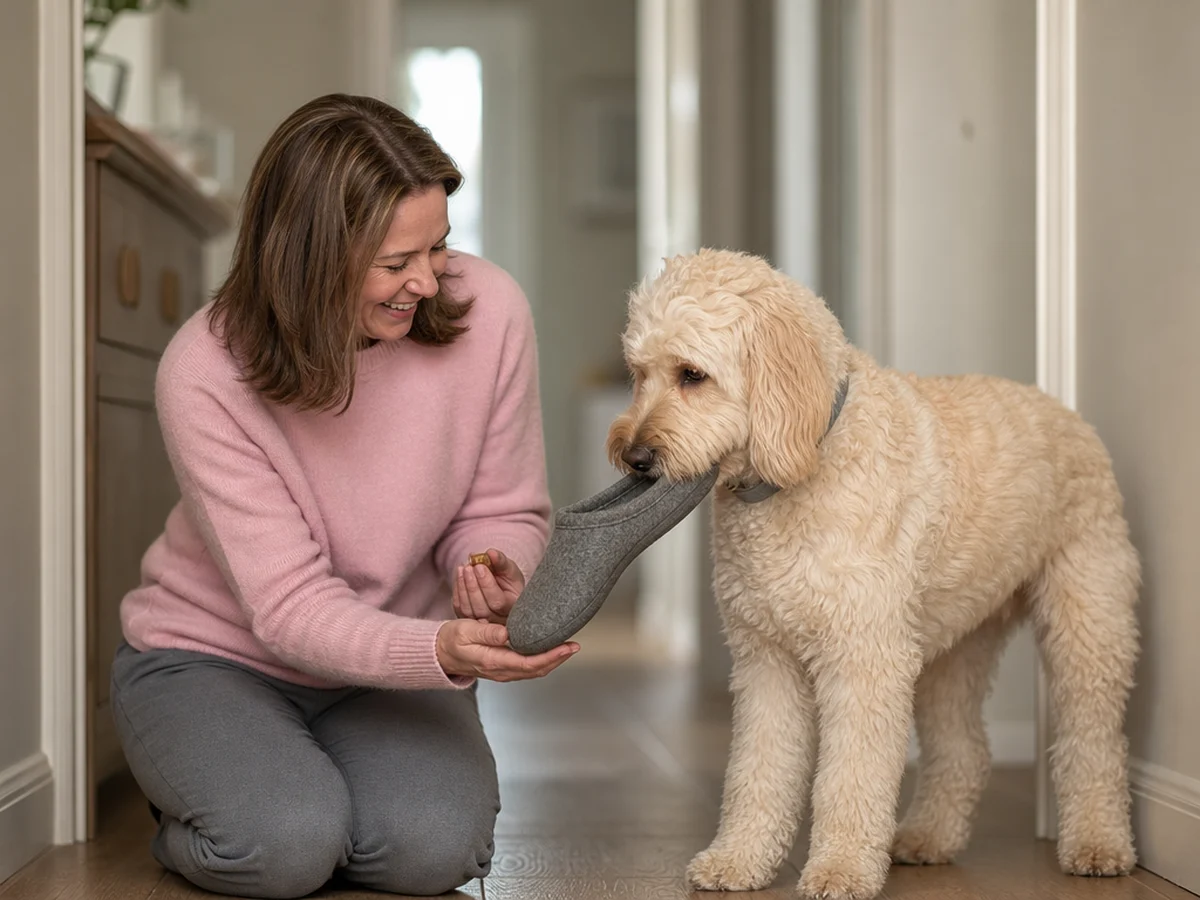
Stealing becomes a habit through what happens next. If you chase, the dog learns that picking something up starts the best game in the house. Common advice says to snatch the item back, but for a dog whose drive is to bring things to you, a calm trade works better and keeps the carrying pointed somewhere useful.
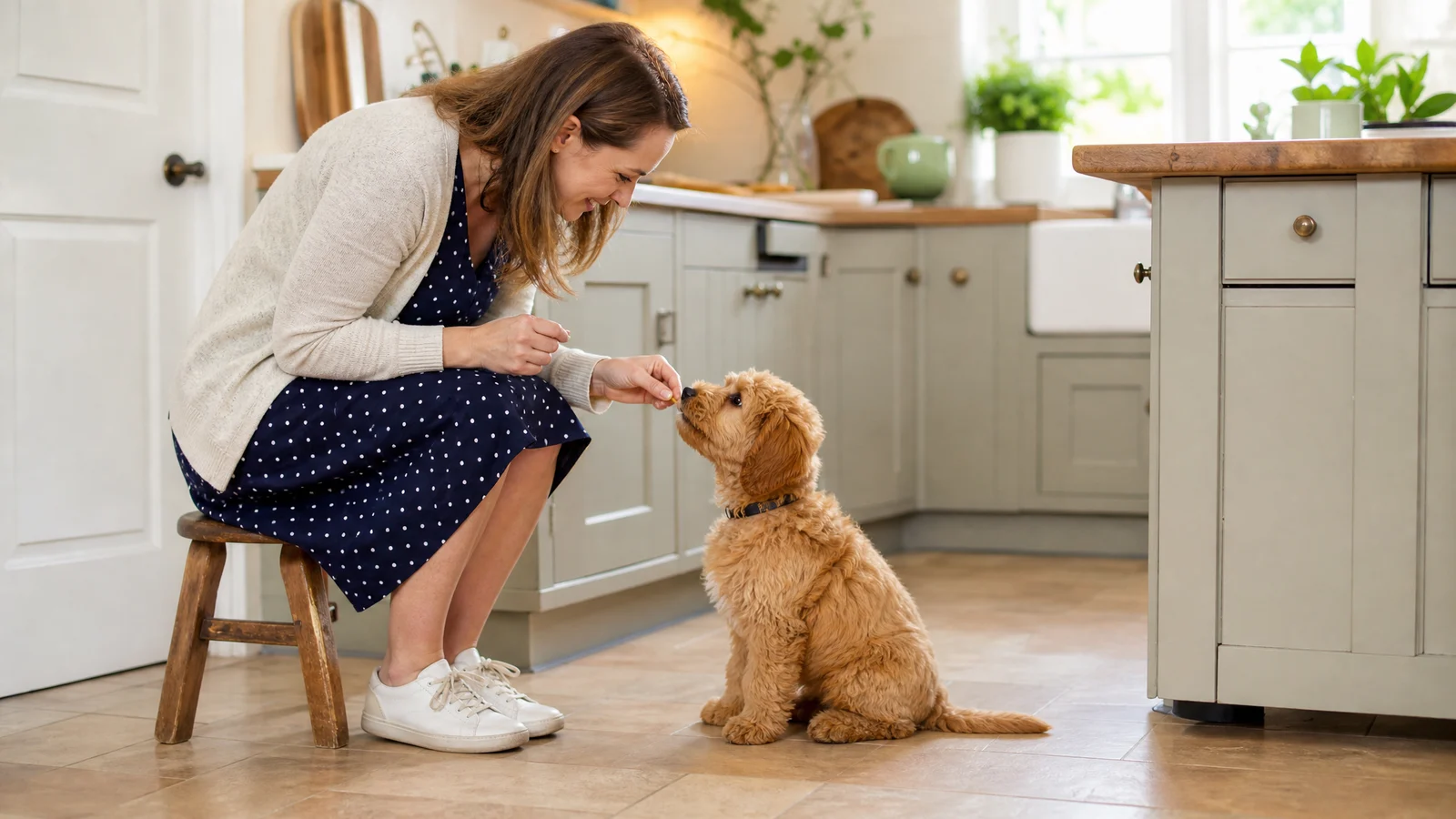
A trade means offering something the dog values more than the item they hold. It runs like this:
- Walk up calmly without reaching for the item, since grabbing turns it into a contest.
- Show a treat or favorite toy near the dog's nose and say your trade cue.
- The instant the dog lets go, say your marker word and hand over the reward. A marker word is a short signal such as "yes" that tells the dog exactly what earned the treat.
- Return the item when it is safe, so letting go does not always mean losing it.
Practice the trade with boring items first, long before the day a sock matters. Because the retrieve impulse is a strength, also reward the carrying you like by praising your dog when they bring a toy to your hand, and keep a basket of approved items within reach.
Management does as much work as training here. Keep shoes, laundry and food off floors and counters so the habit cannot be rehearsed all day. Some Goldendoodles show little interest in stealing, so judge by your own dog.
Why a Goldendoodle Jumps and Mouths Hello
Both parent breeds rate 5 of 5 for openness to strangers, and owners describe dogs who love people, spot them from a long distance and greet with big happy wiggles. Jumping lets the dog reach your face. Mouthing is how a mouth-oriented dog says hello.
The excitement can turn physical. Some owners report grabbing or hitting at visitors, children included, even when the dog only means hello. Setting matters too, because the same dog may sit calmly for strangers in public and be boisterous at home, so greeting manners need practice in each place.
Reading the Trigger
Mouthing often follows a context. A puppy who is overtired mouths more, and so does a dog who wants attention for play or a potty trip and is not getting it. Spotting the trigger tells you whether the dog needs rest, attention or something to chew.
Some puppies skip nipping people and chew furniture instead, and they do well when pointed to a chew toy. Others get very bitey at the sight of someone they love and ignore a toy, going for legs, trousers or skirts. For those puppies, stand up, end the game for a moment, and rejoin when they are calmer.
Teaching a Calmer Hello
Owners report good results from structured calm-greeting routines, and several of these ideas combine well:
- Take the dog outside first and allow only calm petting indoors, which made a difference in about a week for some households.
- Send the dog to a mat or ottoman for scratches and cuddles when you arrive home.
- Scatter treats on the floor as people come in, since most dogs cannot jump and sniff the ground at the same time.
- Say a calm interrupt word such as "too much" and turn away, then reward the moment the dog settles.
- Start a relaxation routine at any age, because owners have begun one around 11 months with good effect.
Mouthing That Fades, Returns, or Stays
The common advice that puppies simply outgrow mouthing is only partly true. It can drop to rare, return in a new setting such as daycare, and even escalate to legs and ankles. Some phases last about six months, and a lull is not proof the habit is gone, so keep rewarding gentle greetings in every new place.
Some Goldendoodles keep a gentle version into adulthood, taking an arm or hand in the mouth without pressure to lead you or say hello. This differs from puppy biting and is often meant as a greeting, so hand them a toy to carry at the door. Owners also report excitability easing with age, tolerable around 2, very chill around 3 and roughly normal by 5, though some dogs are still excitable at 3½.
Barking Behavior Problems at Windows and Doorbells
The parent breeds disagree about barking, so Goldendoodles vary. The Golden Retriever's barking level is rated 1 of 5, meaning only to alert, while the Poodle's is 4. Watchdog ratings split in a similar way, at 3 and 5, so a quiet puppy and a chatty one can both be typical.
Start by sorting the sound. Alert barking is short and tied to a trigger, like a doorbell or a figure passing the window, and it stops when the trigger leaves. Boredom barking repeats without a clear trigger, often in the evening, and signals a day with too little work for a dog whose parents rate 4 and 5 for mental stimulation.
Each cause gets a different fix, and the list below pairs them:
- For window barking, block the view with film or closed curtains while you are busy, and reward the dog for choosing a mat instead of the sill.
- For doorbell barking, play the sound at low volume with treats landing on the mat, then raise the volume slowly across many sessions.
- For boredom barking, add a scent game, a stuffed chew or a short training game before the usual barking time.
- For attention barking, answer quiet moments with praise and turn away from the noise.
Turning away works only for attention barking. Alert barking rewards itself because the passerby always walks on, so give the dog a better job, such as going to the mat for a treat. Barking that happens only when you leave is a different problem, tied to distress about being alone, and the crate training article linked at the end covers it.
Digging, Splashing, and Trash-Raiding Behavior Problems
Poodles are excellent water-retrievers, and many Goldendoodles come with a fondness for water that you meet first at the water bowl. Dunking paws, tipping the bowl and splashing across the kitchen all fit that heritage. Digging and trash raiding draw on foraging, and the Poodle side adds an excellent nose.
Each of these is a drive finding its own outlet. A dog who digs is searching, a dog who splashes is playing in water, and a dog who tips the bin is following their nose to something that smells rewarding. Blocking the behavior does not remove the urge, so give it a legal home.
- Offer a shallow wading pool for supervised splashing, and use a mat or a heavy bowl in the kitchen so the water bowl stays upright.
- Build a dig spot with loose soil or sand, bury treats and toys there, and praise every dig in that spot.
- Use snuffle mats and treats scattered in grass to give the nose daily work.
- Keep bins closed, latched or inside a cabinet, because management beats willpower when the smell is irresistible.
If your dog does raid the trash, trade calmly for a treat instead of chasing, and call your veterinarian if they swallowed something unsafe. A dog who gets a chase learns that bins start the best game. Plenty of Goldendoodles never dig at all, so build these outlets only where you see the urge.
Chewing and Pacing Behavior Problems From Unspent Energy
Destructive chewing and restless pacing are the same story told twice. Energy rated 3 and 4 plus mental stimulation rated 4 and 5 means a Goldendoodle can finish a walk with the body satisfied and the mind still working. That leftover need shows up as chewed furniture, hallway pacing or circling by dusk, which owners often read as naughtiness.
The usual advice is to walk the dog longer, and it is only half right. The PDSA notes that a good exercise routine may improve unwanted behavior but is unlikely to fix it completely, and exercising a stressed dog in a busy place can make them more stressed. A quiet sniffing walk often settles a wired Goldendoodle better than a long, exciting one.
A realistic day mixes several kinds of work, roughly in this order.
Start with a walk that leaves plenty of time to sniff, not just to cover ground. Follow it with a play session that ends before the dog gets frantic, then a short training game or scent search with treats. Once the search is done, a stuffed chew in the pen or on a mat gives the dog a calm way to wind down. Finish with a settle on a mat while you watch TV, and an early bed for any puppy who is overtired.
For chewing, rotate durable chew toys so they stay interesting, and point the dog to them whenever they start on furniture. Regular veterinary visits belong in this plan too, since pain or discomfort can look like restlessness, and any sudden change in behavior deserves a call.
Steering Goldendoodle Behavior Problems and Common Owner Questions
Many of the problems in this article trace to retriever drives that need a job. A Goldendoodle carries a hunting retriever's eagerness from both sides, plus trainability ratings of 5 of 5 from both parents, so the goal is to direct that energy and not to suppress it.
Give your dog things to carry, sniff, chew, splash in and learn, and mouthing, jumping and restlessness lose much of their reason to exist. Separation distress is a different case, since some owners come to see it as true anxiety and not a drive that needs an outlet, and dogs vary.
Expect progress to be uneven, with setbacks in new places. Some owners see behaviors ease as dogs mature, though the timing varies widely and some dogs stay excitable well into adulthood. Owners tend to ask three questions next, and each has its own article.
If you are worried about distress when you leave, the article on Goldendoodle crate training and separation anxiety covers how crates and naps fit into the picture. If you want to know when each of these behaviors will settle, the Goldendoodle puppy training timeline follows every stage. And for the foundation that sits under every fix above, start with the reward-based Goldendoodle training guide.
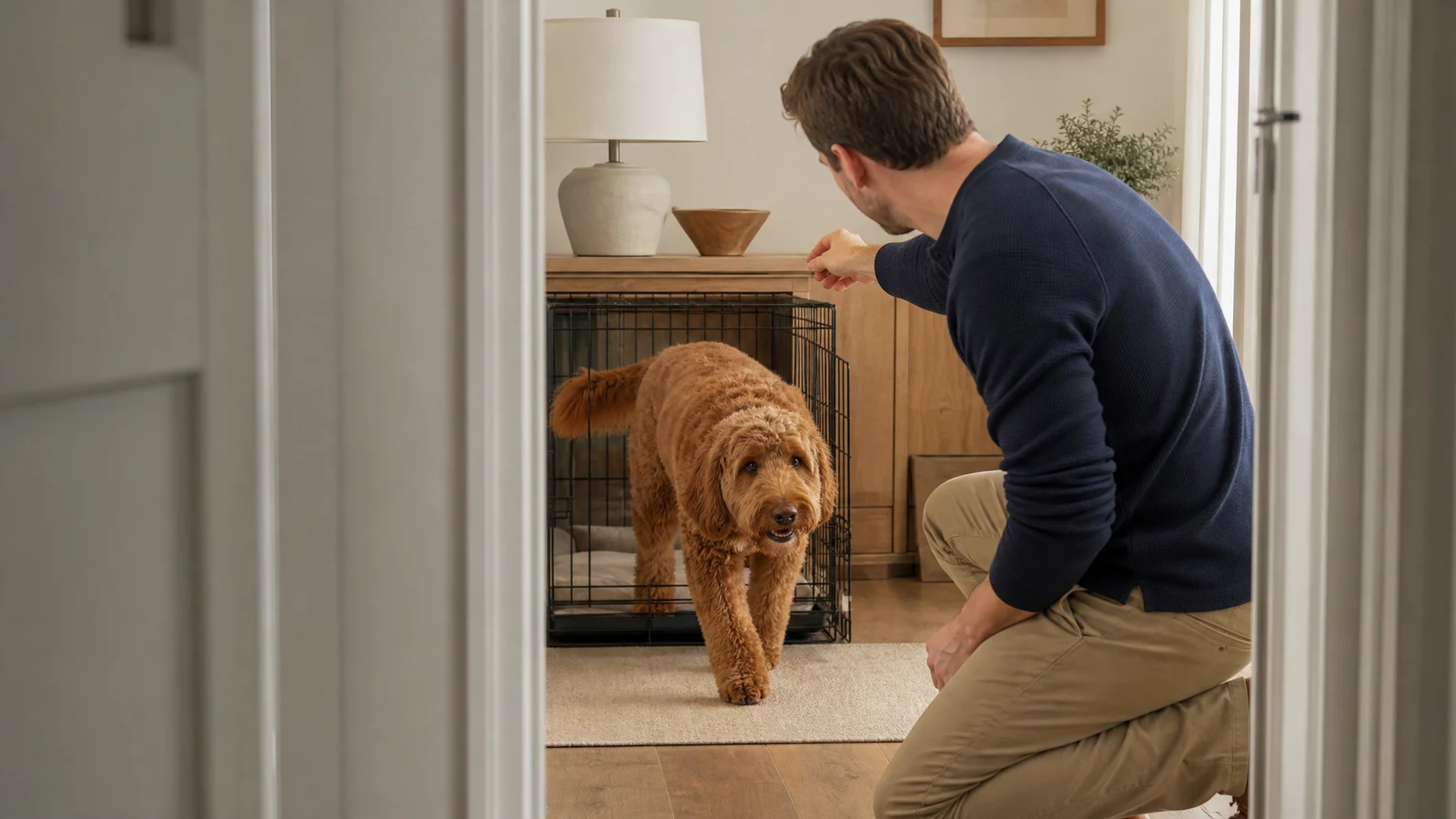 Training basicsCrate Training a Goldendoodle and Preventing Separation Anxiety
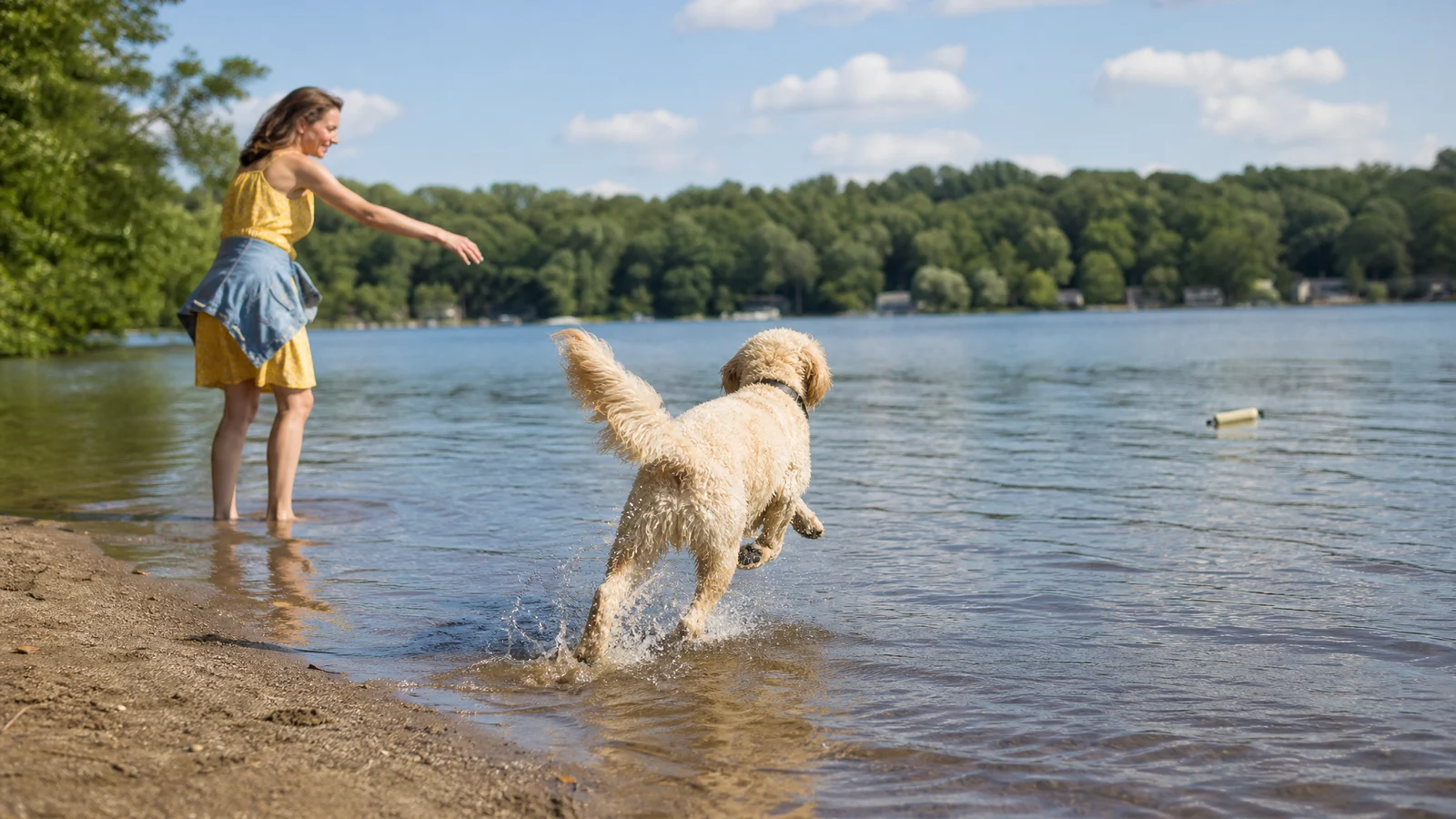 Exercise and jobsGoldendoodle Fetch and Water Play: A Troubleshooting Guide
 Puppy trainingGoldendoodle Puppy Training Timeline, 8 Weeks to 2 Years
