 Goldendoodle

Four months in, your Goldendoodle puppy has probably settled into the house. By six months, the same puppy is reaching higher, pulling harder and testing rules you thought were finished.
Most of this is ordinary growing up. Adult teeth push through, the senses sharpen, and self-control trails behind the body, so a puppy can look ready for more than they can actually manage. None of that means training has stalled, and a puppy at this age can still learn fast when the lessons are pitched at the right level.
In this guide we'll go through what is changing, how to handle the chewing, cues that suddenly wobble, and the walks and strangers that come with a bigger world.
Why a Goldendoodle Puppy Seems Different at Five Months
Several surprises of this stage arrive together because they share one cause, which is growth. Body, mouth and brain are all changing at once, so a puppy who was easy in month three can feel like a different dog in month five. A few points are worth holding in mind:
- Texas A&M's veterinary team places the juvenile stage between 3 and 6 months of age and says a puppy should have all adult teeth in place by 6 to 7 months.
- The same stage is when puppies begin to test boundaries and push limits, which is why a puppy who never questioned the gate last month may suddenly lean on it.
- These are general puppy changes rather than a Goldendoodle calendar, so treat the ages as a rough map and expect your own puppy to arrive early or late.
- What the breed adds is temperament: both parent breeds are described as affectionate and people-oriented, so a Goldendoodle may test the rules with a wagging tail and a cheerful face, which is easy to mistake for cooperation.
Three jobs follow from all this: make chewing safe and rewarding, lower the difficulty on cues that wobble, and widen your puppy's world at a pace that keeps it fun. That is why small changes in routine count for so much at this age. A chew handed over on time, an easier ask on a bad day and a stranger approached at a comfortable distance each point your puppy's growth in a direction you chose, and none of it takes grand gestures.
Chews for a Puppy Whose Adult Teeth Are Coming In
Teeth are the change most people notice first, usually because something they own now has a bite taken out of it. The mouth is busy for good reasons, so the goal is to give it better work rather than to stop it.
When teeth meet a hand, a sleeve or a table leg, hand over a chew and praise the moment your puppy takes it. Repeating that swap teaches what a mouth is for far better than scolding does, and it keeps mouthing from turning into a game you join by accident. Our guide to soft mouth manners has the full routine.
A workable chew setup does not need much gear, only the right pieces in the right places. For these months it has four parts:
- A few chews in different textures, rotated so each one feels new again, with one always within reach of a puppy who needs it.
- A rubber toy chilled in the freezer for sore-feeling gums, offered only while you are close enough to catch any piece that comes loose.
- Gates and closed doors that hide shoes, charging cords and remotes, because a stored shoe cannot be chewed.
- A crate or pen for the stretches when nobody can watch, introduced before your puppy is tired and cranky rather than after.
The gate usually earns its place before the toy does, since anything out of reach needs no supervision at all. Keep regular vet visits on the calendar through these months and bring up chewing or mouth questions there, because that is what those appointments are for. Our trade-up games for Goldendoodles who chew shoes pick up where this setup leaves off.
Cues a Goldendoodle Puppy Knows but Cannot Always Use
Chewing is easy to see, while the cue that quietly stops working is harder to read. A sit that was automatic last month can turn into a blank stare in the middle of a sidewalk.
Most puppies reach adolescence around 6 months, though it can start later, and a few early signs often show before this stage ends. Adolescent puppies are often more impulsive than adult dogs and may overreact, partly because the still-developing prefrontal cortex that handles self-control has not caught up.
A missed cue at this age is more likely a puppy who cannot manage than one who will not, so the fix is an easier request instead of a louder one. Here is a refresher routine we would use for any cue that has gone wobbly, and it fits between meals and walks:
- Go back to the easiest setting you have, usually a quiet room with a few treats in your pocket, and ask for the cue once.
- If your puppy does it, pay right away. If not, make the request easier by moving closer, using a treat as a lure or waiting for a calmer moment, rather than repeating the word.
- Adjust only one variable per step, whether the room, the distance or a small distraction, and only after your puppy does the cue smoothly several times in a row.
- End while your puppy is still keen, so the last thing they remember is an easy win.
A people-loving puppy makes it tempting to skip steps, because those eager eyes look ready for the next one long before their self-control is. The complete Goldendoodle training guide shows how each cue fits into the bigger plan.
Walks and Strangers for a Growing Puppy
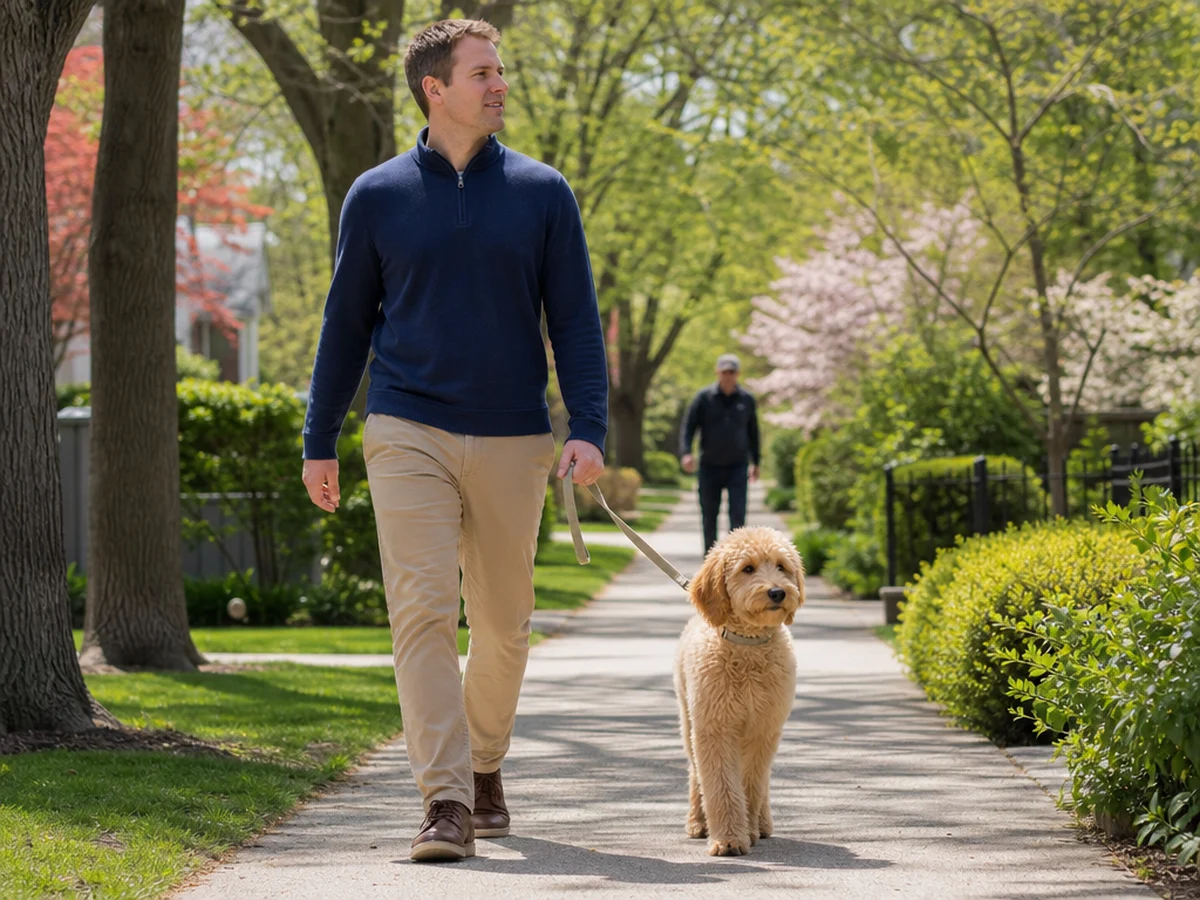
The last big change shows up outside the house, where a puppy who can see and run farther meets a bigger world, and the world answers by being more distracting. Two things tend to show it first, which are the leash and the way your puppy greets people. At around 5 months a puppy's eyesight gets better, and with stronger legs walks can get off track as the puppy pulls toward new sights and smells.
On the Leash
For the leash, being consistent every time you head out matters more than any single trick, because a puppy who is sometimes allowed to pull learns that pulling sometimes works. Our leash training guide lays out the method.
With Strangers
Even a friendly puppy may also show some fear toward strangers as they get older, hiding or barking included. Both are phases to steer with rewards and never to punish.
For strangers, pair the new person with a treat from a distance where your puppy stays comfortable, let that person move away, and never push a hello, because the treat is what teaches your puppy that strangers predict good things. Move closer only after your puppy stays relaxed, and use the guide to socializing a Goldendoodle for the longer plan.
Loose Ends in a Five-Month Puppy's Week
None of these three belongs to a single lesson. Each one still shapes how smoothly the rest of this stage goes.
What if my puppy still mouths at five months?
Some mouthing is normal at this age, and play biting does not mean your puppy is vicious. Keep swapping in chews, end the game when teeth land on skin, and watch whether the habit is fading. If it has not eased by the time your puppy is 6 months old, it is a good idea to consult a trainer or behavior specialist who uses rewards.
Can my puppy go off leash with dogs yet?
Most puppies this age are not ready, because off-leash freedom needs a recall that holds up around distractions. A long line gives your puppy room to run and sniff while you keep the safety of a leash. Practice calling at several points during the walk, and call only when you plan to be pleasant, using our recall guide for the steps.
What if my puppy growls over a chew?
Treat the growl as a warning rather than misbehavior and never punish it, since a puppy who is punished for warning may skip the warning next time. Trade instead: walk up, offer something better, and give the chew back when the swap is done. If you think your puppy might bite, or the guarding is new and intense, ask your vet for a health check and bring in a reward-based trainer.
Where a Goldendoodle Puppy's New Reach Can Go
Growth gives your puppy a longer reach, and nearly everything above comes back to it. The same legs that clear a counter can learn to settle on a mat, the same sharper eyes that lock onto a squirrel can learn to check in with you, and the same mouth that finds the shoes can learn to carry a toy.
Reach is neutral, and what you reward decides where it goes. It takes noticing, each day, where your puppy's reach is heading.
Your puppy's needs change month by month, so we built our Goldendoodle e-book to follow the whole journey, with enough depth to lean on and plain enough to read in the gaps between walks. Anyone raising a Goldendoodle can have a copy without paying a cent.
 Training basicsGoldendoodle Temperament: What It Means for Training
 Puppy trainingGoldendoodle at 6 to 12 Months: Adolescence Begins
 BehaviorTraining an Older or Adopted Goldendoodle
