 Goldendoodle

A first birthday does not switch a Goldendoodle into a calm dog. Across dogs in general, social maturity develops at 12 to 36 months of age, so the stretch that counts is the one you are standing in right now.
For your Goldendoodle that means calm will come in layers, sooner in some rooms and later in others, and a quiet week can be followed by a rowdy one without anything having gone wrong. Your part is to make calm easy to find and worth repeating, one situation at a time.
This page covers what to expect after year one, how to pay for calm on the rug and at the door, and how exercise and play can help or get in the way. The full methods for each skill live on their own pages.
Why Calm Arrives in Pieces for a Goldendoodle
The 12-to-36-month window is wide because maturity is not a single event. Dogs grow up socially and behaviorally in overlapping phases, which is why AAHA's life stage guidance describes the span from about 6 months to 3 years as one that can be the most challenging for owners.
What Your Goldendoodle Adds to the Mix
A Goldendoodle may add a few wrinkles of their own. Their retriever side may keep a playful, puppyish streak well into adulthood, and their Poodle side may bring a need for good exercise every day, so a dog who looks grown can still carry plenty of energy into the house. Neither trait is guaranteed in a cross, which is one more reason to watch your own dog instead of a chart.
Finding Where Calm Already Lives
So the useful question is not when your dog will be calm, but where they are calm already and where they are not. Rest at home, hellos at the door and play with other dogs each move at their own speed, and each is worth its own plan, starting with the place your Goldendoodle already lies down.
Paying for Calm Where Your Goldendoodle Already Rests
The rug is the easiest place to begin, because your dog is already there and you are not asking for anything yet. A Goldendoodle who drifts onto a bed by themselves is practicing calm for free, and every one of those moments you pay for makes the next one a little more likely. The routine below borrows its footwork from mat training for Goldendoodles. Keep it low-key, because the goal is a dog who chooses the mat, not one who has been hurried onto it.
- Put the mat or bed where the household gathers, such as beside the sofa, so settling happens near people instead of in exile.
- Wait for your Goldendoodle to lie down on it, or ask once and then simply wait, because a dog who hears a cue over and over learns to wait for the repeats.
- Pay while your dog is lying down, with a small treat dropped between their paws and a quiet word, so the reward arrives at the level of the behavior you want.
- Stretch the time between treats a little each session, and go back to quicker payment if your dog pops up, since getting up tells you the stretch was too long.
- End the session while your dog is still settled, and let them stay put or wander off on their own terms.
Making Settling a Choice
Pairing lying down with something pleasant turns a settle from a rule into a choice, and a choice is what holds up once the doorbell rings. When the mat works in one room, carry it to the room nearest the front door, because that is where the next test waits.
Leave settled moments alone more often than you reward them. Step around the dog, keep your voice low and let the nap finish, and save the bigger rewards for the first moments of settling, when your dog has chosen it over something more exciting. Over the second and third years those unbroken stretches are what the word calm will mean in your house.
A Calmer Hello at the Door
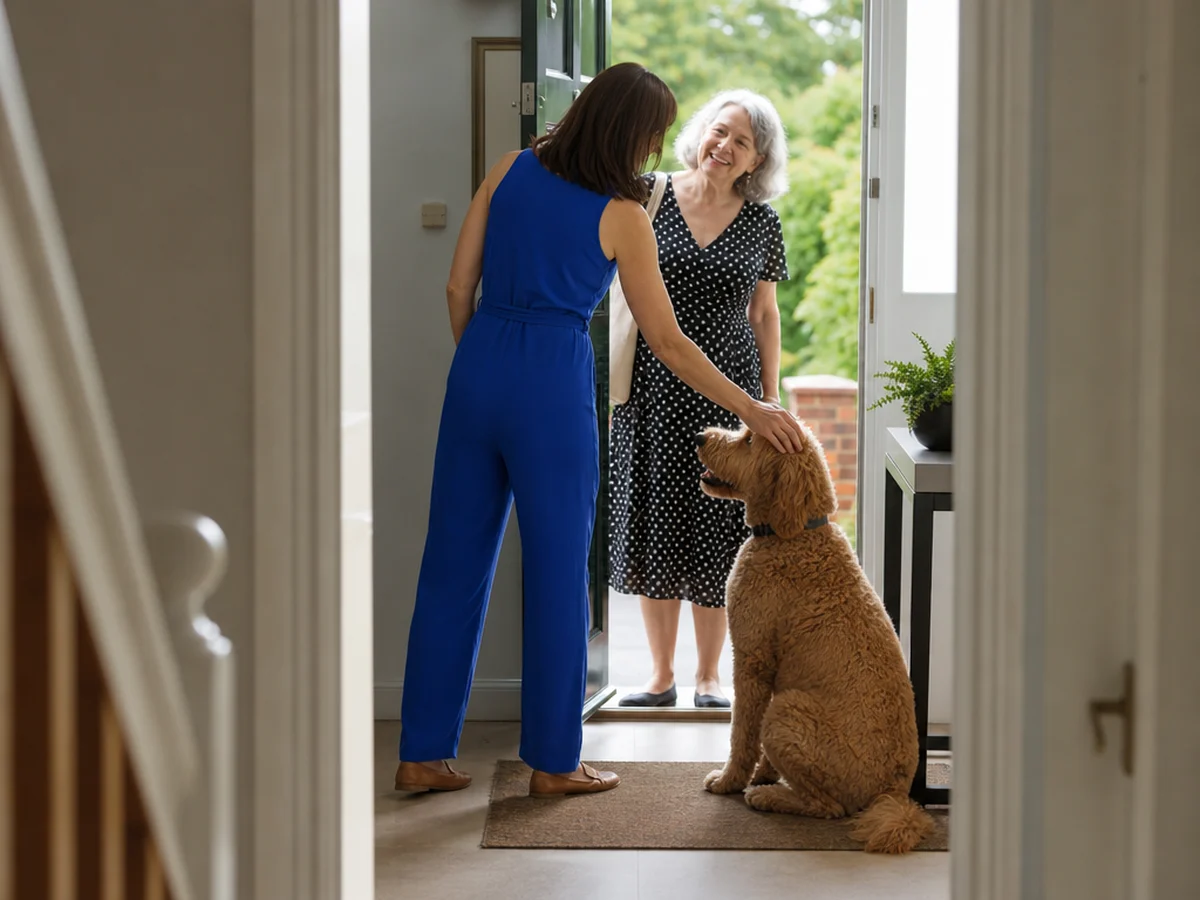
The rug teaches calm when nothing is happening, and the front door tests it when everything is. Goldendoodles come from two very people-oriented parent breeds, so the hello may stay the biggest moment of their day long after the puppy months, and a one-year-old can reach a guest's knees with real momentum.
Aim for a short burst of joy followed by a settle, not a dog with no feelings about visitors. When the bell rings, send your dog to the mat you practiced on, pay them there, and let guests say hello once your dog has settled. The visitor's attention then becomes the best part of the reward, which teaches more than any speech about manners.
Expect the first tries to be messy, and shorten the ask until it works. Keeping your dog on a leash or behind a gate while the guest waits a moment outside gives everyone a calmer start. Over time the sound of the bell turns into the cue for the mat instead of the cue for the bounce.
Exercise and Play That Leave Room for Calm
The rug and the door both get easier when the day around them is the right size, and more is not always better. Exercise is not a cure for behavior, per se, and the right amount and type of exercise matters more than piling on miles.
Give both sides of a Goldendoodle an outlet: a brisk walk or a game of fetch for the body, and a hidden-treat game or a puzzle toy for the mind. Finish games on purpose.
Pause the fetch, ask for a sit or a down, restart only when your dog has settled, and stop a little before they run out of steam, so the last thing they learn is how to stop. Our guide to retrieving games has more ideas.
Play with other dogs may change across this stretch too. As dogs mature, some may lose interest in playing and others may play more roughly when excited, so a friend who suited your puppy may not suit your adult. Choose playmates and settings your dog enjoys, and our guide to polite play with other dogs shows how.
Questions About Calm After the First Birthday
A few everyday situations do not fit neatly under rest, hellos or exercise, so they get short answers of their own here. Each one is a place where calm is easy to lose and worth the trouble of rebuilding.
Can my Goldendoodle settle while I work?
Yes, and a working day is a good place to practice because you can pay the settle without any fuss. Put the mat near your desk, hand over a safe chew, and drop a treat on the mat whenever your dog lies down on their own. If they keep coming over, walk them back once, pay the settle and return to work, so settling is what earns your attention.
Do Minis and Standards calm down alike?
We would not count on size to set the timeline. A Standard's bounce is harder to live with because there is more dog behind it, and a Mini's is easier to overlook, but neither size guarantees an earlier or later calm. Use the same rug routine for both and judge by how quickly your own dog comes back down after excitement.
What if calm only lasts a minute?
A minute is a real start, so pay it. Short settles add up when you keep paying for them, and you can stretch them by waiting a moment longer before each treat once your dog lies down reliably. If calm keeps falling apart or your dog's behavior changes suddenly, mention it at a regular vet visit and ask whether a trainer would help.
Letting a Settled Dog Stay Settled
Once those minutes of calm start arriving without being asked, the temptation is to celebrate with a pat, a cheerful word or a toy waved in hope of a game. A settle that ends because someone got excited teaches your dog that the best things happen right after they get up.
Calm is one skill in a long list, and the e-book we wrote for Goldendoodle owners walks through the rest of it in plain, complete detail, from puppy basics to adult manners. Anyone who joins our reader list gets a copy to keep.
 Puppy trainingHow to Socialize a Goldendoodle Puppy
 Training basicsHow to Teach a Goldendoodle to Sit
 Training basicsHow to Teach a Goldendoodle to Stay
