 Goldendoodle

Ask almost anyone what a Goldendoodle is like and the answer comes quickly: friendly. It is true often enough to be useful and incomplete enough to cause trouble the first time a lesson goes sideways. Read on and you'll find the traits a Goldendoodle may inherit from the two parent breeds, what each one asks of you when you train with rewards, and how to judge a missed cue fairly before you decide your dog is being difficult.
None of this takes special equipment. It takes a clear picture of the particular dog at the other end of your leash, and that is the one thing a breed description cannot hand over.
Put together, a sociable, quick and springy temperament like this one changes what counts as a reward, what a missed cue means and how much a young dog can absorb in one sitting of training.
What a Cross Between Two Breeds Does to Temperament
A Goldendoodle arrives with a reputation but no breed standard of their own, so the closest thing to a description comes from the two breeds behind the cross. The Golden Retriever parent is described as eager, alert and self-confident, with a friendly and reliable nature.
The Poodle parent is described as very active, intelligent and proud. A Goldendoodle may inherit any mix of those traits, so one dog can lean toward the retriever's easy warmth while another from the same cross leans toward the Poodle's busy intensity.
That variety is why labels like stubborn or easy deserve suspicion. A behavior team at the Dumb Friends League makes the point that certain breeds are not more defiant than others, though they often have different needs, skills, intelligence and activity levels.
Seen that way, the useful question is therefore which needs this particular dog has. Temperament describes tendencies, not outcomes. A lively dog can learn to wait and a cautious one can learn to greet with confidence, but training goes better when it works with the tendency instead of against it. That is the working idea behind the rest of this page: spot the trait, then give that trait a job and a reward.
Four Moments That Show the Traits
Because the picture is mixed, we find it more useful to watch for traits than to guess at parents. These four moments show them best:
- The greeting, when your dog either rushes in with their whole body, hangs back to look first, or heads straight for your attention.
- A short wait with nothing happening while you reach for a treat or a leash.
- Something new, such as a vacuum, an umbrella or an unfamiliar floor, and whether curiosity or caution comes first.
- The end of a game, and whether your dog can come down from the excitement or stays revved up long after it stops.
Write down what you notice over several days. Patterns across those moments tell you far more about your dog than any single trait on a breed page, and they point to the sections below that matter most in your home.
A People-Loving Temperament Still Needs Clear Rewards
The greeting is usually where a Goldendoodle's love of people shows first, and it is also the clearest clue to what pays best in training. The Golden Retriever side is described as friendly and devoted, and the Poodle side as very people-oriented, so your attention may be worth more to a Goldendoodle than the treat in your hand.
Poodles are quick to please when training routines are fun and positive, as long as you stay consistent about what you ask, a pairing spelled out on the AKC's Poodle page.
That cuts both ways. Attention pays for everything, including a jump on a visitor, a nudge at your elbow and a bark from the next room, so a dog who loves people will happily work for the wrong kind of notice if nobody shows them what earns the good kind. Decide ahead of time which behaviors earn your eyes, your voice and your hands.
Everyone in the House Is Part of the Plan
When people are the favorite reward, every person in the home is a reward dispenser. If one family member pays for four paws on the floor and another laughs at a jump, a Goldendoodle will reasonably decide both are fine, and nothing clever on your side can undo that. Agree on two or three behaviors, such as sitting for a greeting, and let everyone pay for them the same way. Our polite greetings guide turns that agreement into a routine.
Then mix up the rest of the pay on purpose. Food is dependable, a short game of tug or fetch suits a dog with a playful streak, and a warm word with a scratch helps on days when treats are not exciting enough. A reward only works if your dog wants it, so notice which one makes their whole body wiggle and save it for the hard moments.
Goldendoodle Energy Before and During a Lesson
Praise and play only work if your dog can take them in, and a Goldendoodle who is wound up cannot. Both parents come with energy attached. The Golden Retriever side is described as energetic and fond of outdoor play, and the Poodle side as very active, so a Goldendoodle may need plenty of daily movement before a lesson has any chance of landing.
The guide to excitability and settling covers how to calm a keyed-up dog, so here we only care about how that energy shows up in training and what it does to the way your dog takes a reward, a treat or a word of praise.
A Lesson Shape for a Lively Dog
What matters is the order of a lesson. Wait for the first wave of energy to pass before you ask for anything hard, and let an easy win come first, since success on a simple step gives you a calmer dog to teach. Keep each lesson short enough that your dog is still keen at the end, because a tired or bored Goldendoodle starts finding their own entertainment. A lesson shape that suits a lively Goldendoodle looks like this:
- Let the first rush of energy pass, with a few quiet minutes in the room where you will work.
- Ask for something your dog already does well and pay it generously.
- Teach one new thing, kept small enough that your dog can succeed.
- Finish with another easy success, then release your dog to play.
The last step matters more than it looks. Ending on play shows your dog that lessons lead somewhere good, so a Goldendoodle with a playful streak may start arriving at lessons looking for the game instead of dodging them. If the keyed-up moments mostly happen around other dogs, the guide to play with other dogs goes further.
Gentle Handling for a Sensitive Goldendoodle Temperament
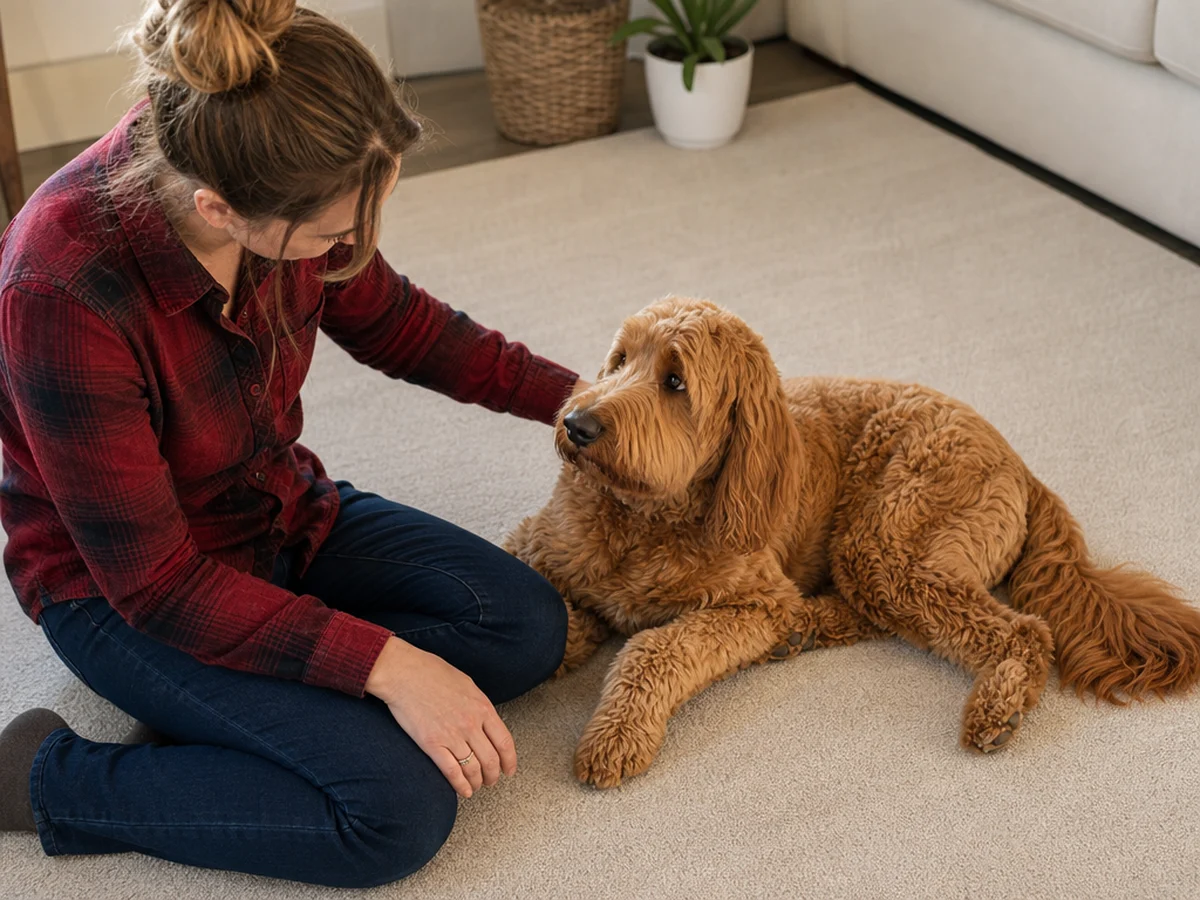
Energy is the loud side of the temperament, and the quiet side shows up when a Goldendoodle meets something new and stops to think. Neither parent breed is described as a shy or nervous type, so a Goldendoodle who hangs back deserves patience rather than pressure.
Early experiences carry a lot of weight for a sensitive dog, and socialization works on quality over quantity. A puppy who meets children who frighten and overwhelm them learns that children are frightening and overwhelming, while one quiet, polite child at a time, approached on the puppy's own terms, teaches the opposite.
Letting a Hesitant Dog Look First
Sights, sounds, surfaces and handling count as much as people and other dogs, and a busy scene can overwhelm a sensitive puppy when it all arrives at once. Split a new experience into small pieces and give each one its own easy practice, with a treat for every calm look.
Soft handling follows from the same idea. Speak quietly, let your dog look at the new thing from a distance that feels comfortable, and reward calm looking before you invite them closer. A hesitant Goldendoodle who gets to choose the pace may gain confidence faster than one who is hurried toward the scary thing.
If your dog stays fearful despite gentle practice, or their behavior changes suddenly, your vet comes first, and regular vet visits are worth keeping up so a physical cause is not mistaken for temperament. Our guide to socializing a Goldendoodle lays out the wider plan.
Reading a Missed Cue Before Blaming Temperament
With the traits in view, the moment that tests them is the cue your dog seems to ignore, and the word owners reach for is stubborn. Before settling on that word, check the plan rather than the dog. A Goldendoodle who walks away from a sit may be telling you something about the setup instead of their character, and these four questions are the place to start:
- Does your dog truly know the cue in this spot, or only in the kitchen where you practiced it?
- Is the reward worth more to them right now than whatever else is happening, such as a visitor, a squirrel or a game?
- Are they too wound up or too unsure to think, which would point back to energy or sensitivity?
- Is something physically off, like a sore paw or a change in how they move, that is worth raising with your vet?
Work down the list in order and change one thing at a time. On the first question the fix is an easier practice spot. On the second it is a better reward. On the third it is more distance or a calmer start, and on the fourth it is a vet visit before any more training. That is good news, because nearly every one of those fixes is in your hands.
Everyday Questions About a Goldendoodle's Personality
A mixed temperament leaves a few questions that no single breed page can settle, because the answer depends on which traits a particular dog inherited. Here are three about planning ahead with a Goldendoodle.
Can I tell a puppy's temperament in advance?
Not with certainty. The traits above describe the two parent breeds, and a cross may inherit them in any mix, so they set expectations without promising a result. Watch how the individual puppy handles greetings, waiting, new things and the end of play, and plan around what you see instead of a label.
Will a Goldendoodle stay playful as an adult?
Quite possibly. The Golden Retriever parent is described as joyful and playful and as keeping a puppyish streak into adulthood, and a cross may inherit that. Build play into the plan as a reward and an outlet instead of waiting for it to fade, and keep lessons short and upbeat so the playful side works for you.
Does a friendly Goldendoodle still need classes?
Friendly is not the same as skilled. A sociable dog can still jump on guests, pull on the leash and ignore a cue in a busy room, and a class gives you a place to practice around other people and dogs with a reward-based instructor beside you. Look for one who uses treats, toys and praise and who lets a hesitant dog watch before joining in.
Habits That Work Whichever Parent Shows Up
Those answers keep returning to one point: a Goldendoodle's temperament is a mix you learn by watching, not a fact you can look up. Some days your dog may seem like the eager retriever, wiggling for your attention, and other days like the busy Poodle, inspecting everything twice. You may never be able to say which parent is steering on a given day, and you do not need to.
The habits worth building are small ones. Start each lesson calm, pay the behavior you want with whichever reward your dog values most that day, and teach one clear answer for the moments that matter, such as a greeting or a wait at the door. Each of them works whether the day brings the retriever's warmth or the Poodle's busy mind, which means you are training the dog you actually have instead of a guess about their family tree.
A mixed temperament turns up a different set of training questions in every home, so our Goldendoodle e-book is built to cover everything a dog like yours has to learn, in full and without jargon, and it arrives by email at no cost once you sign up here.
 Puppy trainingGoldendoodle at 6 to 12 Months: Adolescence Begins
 BehaviorTraining an Older or Adopted Goldendoodle
 Training basicsHow to Teach a Goldendoodle to Come When Called
