 Goldendoodle
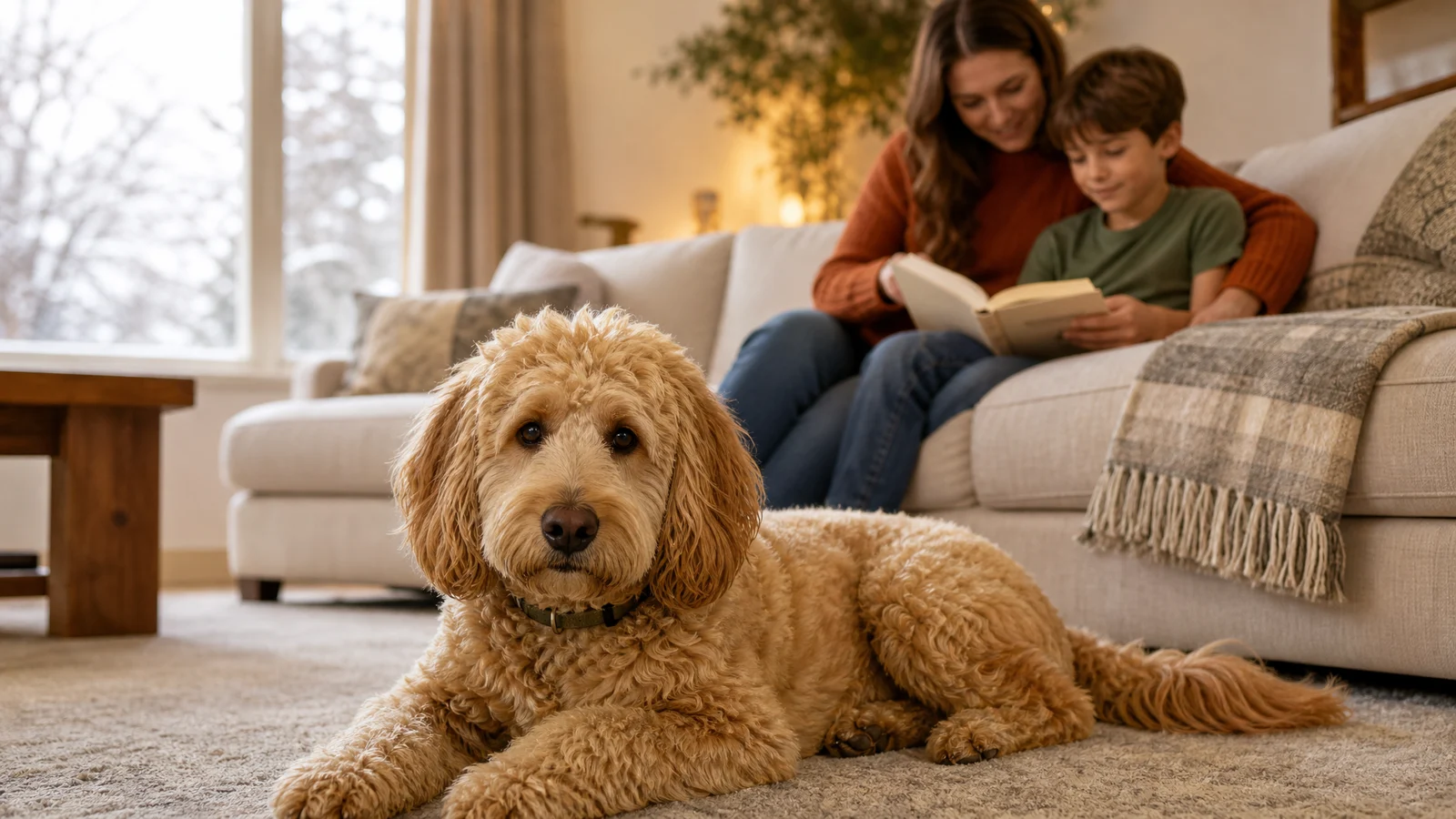
Most Goldendoodles are thrilled to live with children, and that thrill is the part families end up training. A dog who adores every small person in the house can knock over a toddler or mouth a sleeve long before anyone is upset, let alone hurt.
So the honest answer to the title is usually yes, with conditions. How a Goldendoodle turns out around children depends far more on how the household sets things up than on the label, and because this cross has no breed standard, nobody can promise a temperament in advance. What you build matters more than what the dog brings.
This page covers who is really responsible for the dog, the rules children need at each age, the retreat every Goldendoodle should have, and the training that turns a bouncy welcome into a gentle one.
Why a Friendly Goldendoodle Still Needs Rules Around Children
Friendly describes how a Goldendoodle feels about children, not how their body behaves around them, and the gap between the two is where most trouble starts. A dog who loves company wants to get close fast, and speed is exactly what small children cannot handle.
Both parent breeds are known as people-oriented and playful, and a Goldendoodle may inherit that warmth along with the puppyish streak of the Golden Retriever side. Size is harder to predict, because the Poodle side comes in three sizes. A big, excited dog can knock a small child down with no ill intent, while a small one is easy to hurt by accident in return.
Then there is the question of who does the work. Plenty of families bring a Goldendoodle home for the kids, but that is an unrealistic expectation, because children cannot be solely responsible for a dog. They can help, learn and take on real jobs as they grow, while an adult stays the dog's main caretaker for life.
That is why we write this page for adults first. Once the adult is carrying the plan, children only need a short set of rules they can follow at their own age.
House Rules for Children, Sorted by Age
A four-year-old and a fourteen-year-old are not the same audience, so the rules grow up with the child. A few of them never change, though, and those come first because each one protects a moment when a good dog could be pushed past their limit.
Six rules apply to every child who lives in or visits a Goldendoodle household, whatever their age. Keep them short enough to say from across the room:
- Crates and Beds Are Off Limits: no child climbs into the dog's crate or plays on their bed, because that is the one place the dog is meant to be left alone.
- Eating time is private: nobody reaches toward a Goldendoodle who is eating or chewing, and nobody takes a bowl or a chew away from them.
- Sleeping dogs stay asleep, so no child wakes a resting dog, lies on them or climbs over them.
- No hitting, pulling or yelling. A dog who gets teased learns that children mean trouble, and every later meeting gets harder.
- No hugging or kissing the dog, since a hug can feel like being trapped. A gentle scratch under the chin is easier for a dog to accept.
- Young children never hold the leash alone. A bouncy dog can pull a small walker off their feet, whatever the dog's size.
Put the list where the whole family can see it, and say the reason out loud the first few times. Children keep a rule longer when they know what it protects, and the adult enforces it, since remembering is not a job to hand to a four-year-old.
Children Under About Five
Young children cannot hold back an impulse, even on a good day, and their movements look loud, jerky and unpredictable to a dog. That combination is hard on a dog who is already bouncing.
So the relationship works best when it is mostly hands-off. The adult steers the child away from the dog unless the dog clearly asks for attention, and a gate or pen separates the dog from a child who is crawling or lying on the floor. Sharing a room calmly is the whole goal at this stage.
School-Age Children
Once children can follow directions, they can learn to read a dog, and that changes what you can ask of them. Teach them to pet for a few seconds, take their hands away and watch. If the dog nudges a hand or leans in, a few more seconds of petting is fine. If the dog walks off, yawns or licks their lips, the visit is over.
This pet, pause, watch routine gives a child something to do with their excitement, and it gives the dog a vote. An adult stays close for all of it, because good intentions fade fast once a game gets exciting.
Teenagers
Teenagers can take on real jobs, such as feeding meals, practicing cues and walking the dog, and those jobs build the kind of friendship a company-loving Goldendoodle enjoys. They still need coaching on body language, so treat them as apprentices, not as substitutes for an adult.
Giving the Dog a Retreat From the Children
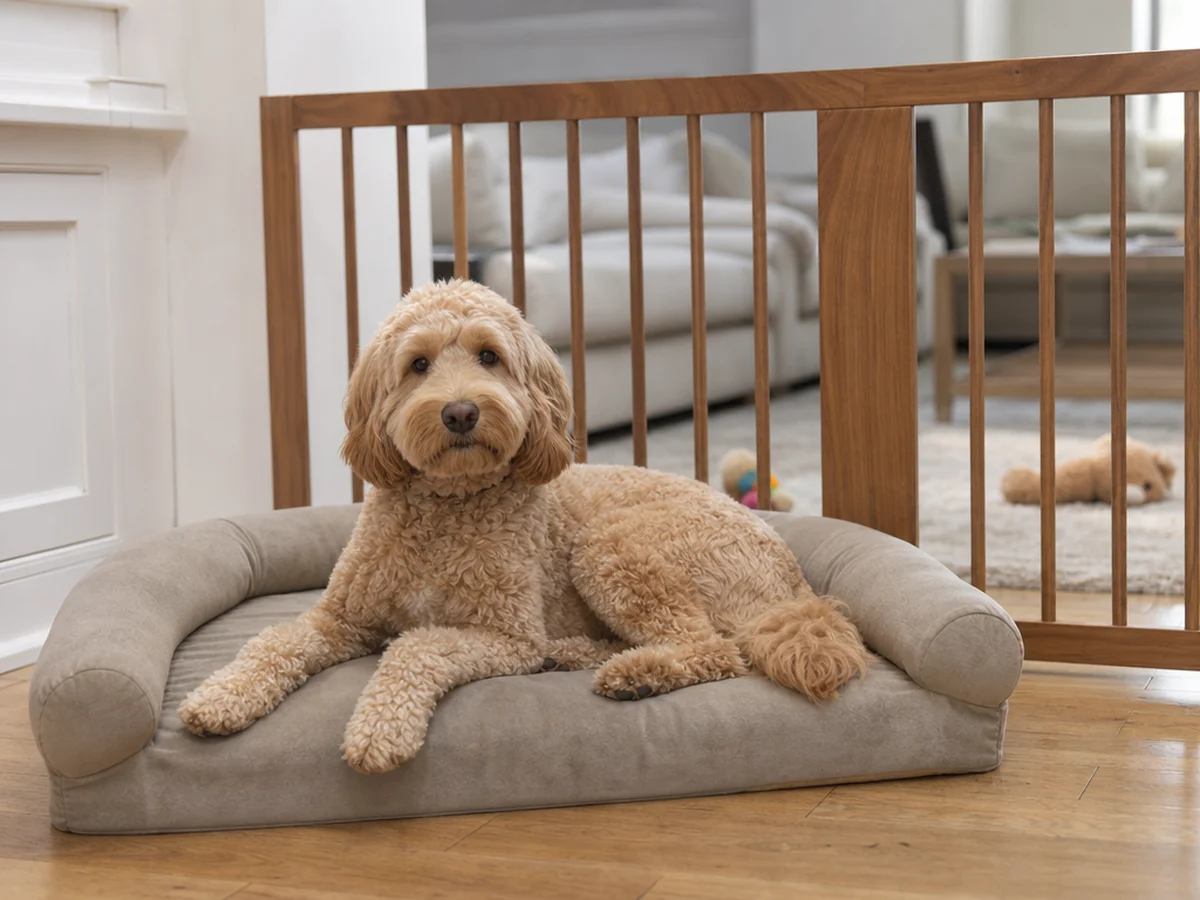
Even a patient dog needs hours with no children in reach, and a Goldendoodle who loves company will rarely ask for them. Rules for children only work when the dog has somewhere to go once the rules run out.
Set up one spot where the dog can rest, eat and chew with no child allowed in. A gated corner, a pen or a crate with the door open all work, as long as the dog can still hear the family going about the day. Our guide to crate training a Goldendoodle shows how to make a crate a place the dog chooses, and the same idea carries over to a pen or a mat.
Use the spot on purpose, never as a punishment. Schedule breaks through the day, send the dog there when meals, guests or loud games begin, and guide them there when the room gets too busy. The dog learns that the break is part of the routine, and the children learn that a closed gate means stop.
Letting the Dog Leave on Purpose
A retreat spot only helps if the dog knows leaving is allowed. Many dogs do not realize that moving away is an option, and a dog who sees no exit may growl or snap instead. A simple walk-away cue gives the dog a safe answer, and it lets an adult send them off calmly the moment a child crawls toward them or the dog looks uneasy.
Teaching the Walk-Away Cue
Teach it with no child involved, using small, tasty treats, and keep your voice cheerful because the dog has done nothing wrong. A Goldendoodle who loves company may need extra pay for leaving it, so be generous. The steps run like this:
- Say your cue, such as "Go away," in a happy tone and toss a treat a few feet away. Repeat many times until the dog turns away as soon as they hear it.
- Say the cue and make the tossing motion without tossing. The moment the dog moves that way, even one step, say "Yes" and toss the treat where they were heading.
- Wait for two or three steps before you say "Yes," then for more, so the cue means walking away and not just a flinch.
- Point toward the retreat spot as you say the cue, then try it with a calm child nearby, paying well when the dog moves off.
Check that leaving is physically possible, too. Clear furniture so the dog cannot get cornered behind a sofa or table, and keep a path open to the retreat spot. A Goldendoodle who gets paid for walking away will keep choosing it, and that keeps small worries from growing into growls.
Keeping a Bouncy Goldendoodle Gentle Around Children
A dog who can leave is only half of the plan, because the other half is making the time together gentle. With a Goldendoodle that means training for bounce: the dive at the door, the grab at a toy and the chase that turns into a pileup.
Greetings at the Door
The doorway is where most Goldendoodle exuberance lands on a child, so start there. Teach a four-paws-down greeting with adults first, then add a calm child, keeping the dog on a leash or behind a gate until the habit holds.
Pay the dog for sitting before anyone is touched, and have the child wait until the dog is calm. Our guide to polite Goldendoodle greetings has the full routine, and it works the same for family members and visitors.
Toys, Fetch and Shared Games
Fetch can be a lovely way for a child and a Goldendoodle to enjoy each other, but only once the dog reliably drops the toy on cue. Until then an adult runs the game. A child never pulls a toy out of a dog's mouth, so the dog drops it and the child waits for space to pick it up.
For a young, enthusiastic dog, choose larger, longer toys, so that a lunge for the toy in a child's hand is more likely to catch the toy than a finger. Keep the child's own playthings out of reach, since a dog cannot tell a stuffed animal from a chew. Our Goldendoodle fetch games page covers building the drop.
Ending Play Before It Peaks
Children move fast, squeal and run, and a playful Goldendoodle may answer by chasing, nipping at heels or jumping up. Stop the game early, before the dog is wound up, by asking for a settle and calling a break. Paying a calm lie-down on a mat while the children are active teaches the dog that quiet earns more than chasing does. If teeth are part of the problem, our Goldendoodle puppy mouthing guide covers the soft-mouth lessons.
Reading the Dog's Signals When Children Are Near
Even a well-managed game ends sooner or later with a dog who has had enough, and children almost never notice the warning on their own. So an adult has to read the dog for them.
Children rarely notice a dog's early warnings, but an adult can learn them quickly. Watch for these signs that a Goldendoodle wants out of the moment, and treat any of them as a reason to end the contact:
- Turning away or leaving the room is the clearest way a dog says no, and it deserves to be respected every time.
- Yawning, lip licking or shaking off as if wet, when nobody has touched them, shows that stress is building.
- A stiff body, a hard stare or a sudden freeze in the middle of a game means the fun has stopped for the dog.
- Mouthiness or jumping that appears only when the children get loud. The dog may be overwhelmed, not misbehaving.
- A growl: it is a clear message, not a reason to scold.
Any of these means the adult ends the interaction calmly and gives the dog space. The earlier the adult acts, the less often the dog has to say it louder.
Stepping In Before the Growl
Children need a move of their own for the moment the dog gets overexcited. Teach them to stand still like a tree, hands folded and eyes looking away. A running, shrieking child is a game to a Goldendoodle and a still one is dull, so the dog settles. The adult then calls the dog away and rewards them for coming.
If a growl does happen, treat it as a favor and act on it. Punishing a growl does not remove the discomfort behind it, it only removes the warning, and the next signal may arrive with no sound at all. If a usually easygoing dog starts avoiding children or snapping, mention it to your vet at a regular visit and ask a reward-based trainer for help.
Visiting Children and New Babies
A dog who is relaxed with your own children may feel differently about their friends, who do not know the house rules yet. Tell visiting children the rules at the door, send the dog to the retreat spot when the energy rises, and never leave the dog alone with any child.
If a baby is on the way, start the new routines weeks ahead. Practice the retreat spot, the walk-away cue and four paws on the floor before the baby comes home, so the dog's life changes gradually and not all in one day.
Decisions Parents Weigh With Children and a Goldendoodle
Size, age and classes all change how the rules above apply. These answers adjust the plan rather than add new rules to it.
Does a Mini Goldendoodle need different rules?
The rules stay the same, but the risks shift with size. A Mini can be hurt by a drop or a squeeze, so young children sit on the floor if they want to hold them. A Standard is sturdier but big enough to bowl a child over in an excited rush, so greeting practice matters most. Either way, an adult supervises.
Can a teenager supervise the dog with younger kids?
A responsible teenager can be a real help, but supervising small children with a dog is an adult's job. Teenagers may not give the dog consistent time, and they can relax too much about body language. Give them walks, meals and practice sessions, and keep an adult nearby for the rest.
Can my child join a training class?
Older children can take part, and it is a good way for them to bond with the dog while learning how the dog learns. Choose a class that uses rewards and welcomes children, and ask the instructor how children take part. The adult still holds the leash for younger children.
Translating Between Children and the Dog
Underneath every rule on this page is one job: translating. Children do not read a dog's yawns or lip licks, and a dog does not understand why a small person is suddenly squealing and running, so someone has to stand between the two languages and explain each side to the other.
At first that adult translates constantly, stepping in before a hug, before a toy grab, before the dog has to leave. In time the children learn to notice the signs themselves and the Goldendoodle learns what children's movement means, so there is less to translate. The adult never stops listening, because the two will always be speaking different languages.
Homework and school runs leave little time to hunt for answers, so our Goldendoodle e-book gathers the training your dog needs into a thorough yet quick read. Register through this site and a copy is sent to your inbox.
 Training basicsIs a Goldendoodle the Right Dog for You? What Training Takes
 Training basicsHow to Choose a Goldendoodle Trainer
 BehaviorGoldendoodle Behavior Problems and the Instincts Behind Them
