 Goldendoodle
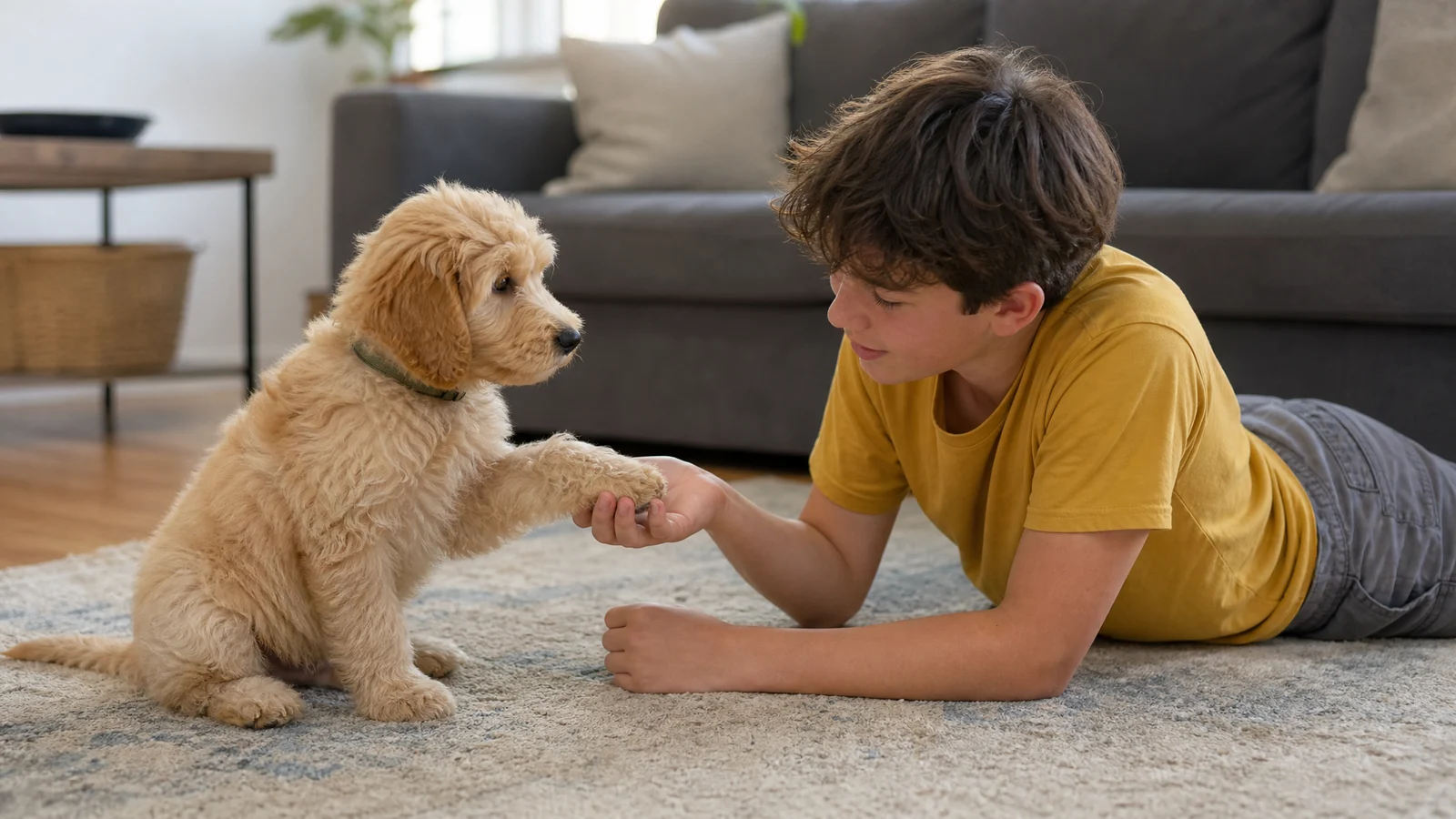
Goldendoodle puppy tricks are easiest to understand as short conversations, not branches that a puppy must unlock in order. One session might reward a calm look at a new object. Another might use a wide curve, one paw touch, or a toy exchange. The useful question is what the puppy can choose comfortably today.
Parent-breed trainability may influence interest, but inheritance cannot promise a retrieve, wave, or polished routine. This guide covers the opening, working, and stopping minutes of a clear reward-based session. We will use a trick menu, safe movement choices, object options, and simple repairs and clear endings so the puppy can learn without completing a fixed skill tree.
Three Jobs in a Goldendoodle Puppy Training Session
Every session needs a readable opening, one small learning question, and a clear finish. Those jobs matter more than the number of tricks practiced. A puppy who understands when training starts and ends can engage without being asked to perform whenever food appears.
Prepare a nonslip area, tiny rewards, a mat, and no more than one prop. Put other objects away. A simple room helps the puppy notice which choice earns the marker, and it lets the handler see whether excitement comes from the task or from clutter.
Choose a brief marker word and pair it with food in a quiet place. Then mark an action the puppy already offers, such as looking toward you. Deliver the reward promptly. The marker identifies the precise choice, while the food supports repeating it.
Add a release cue after the reward and allow movement. Wait for voluntary reorientation before another invitation. This rhythm separates repetitions and shows whether the puppy remains willing. Following the puppy with food would hide that information.
The AKC notes that mental stimulation can include training, scent work, puzzles, and new skills. Trick sessions belong beside suitable physical activity, sleep, feeding, and ordinary play. They should not become a strategy for exhausting a growing dog.
Pick One Menu Row
Select one row from the puppy’s response rather than moving down the table. Each choice teaches a different kind of conversation. The “easy version” is a complete lesson, not merely a step that must be rushed past.
| Puppy’s Current Choice | Trick Question | Easy Version |
|---|---|---|
| Approaches an open hand | Can they touch or follow it? | One palm contact near the nose |
| Investigates a floor target | Will one paw move toward it? | Mark a weight shift |
| Moves with loose balance | Can they follow a broad path? | Several steps around a large landmark |
| Returns with a soft toy | Will they release in an exchange? | Reward a brief pickup near you |
| Settles on a mat | Can training end calmly? | One reward, release, and rest |
A puppy may show two appealing options. Pick the calmer one first and save the other for a different day. Switching repeatedly can create speed without understanding, because the learner begins scanning for the next prop instead of reading the current setup.
Paw use and nose use are not interchangeable signs of intelligence. Some puppies investigate a target with the nose before a paw moves. Reward progress toward the chosen question, or choose another row if frustration rises. Comfort decides which game remains available.
Do not use the menu as a checklist. A Goldendoodle puppy can enjoy palm targets for weeks and ignore toy work. The session is successful when one small response becomes clearer and the puppy can leave easily, even if no recognizable party trick appears.
The Opening Minute of Puppy Training
The first minute gathers information. Bring the puppy into the prepared area, wait for orientation, and mark one offered response. Avoid announcing several cues. A quiet opening shows whether the learner can eat gently, return attention, and move comfortably on the surface.
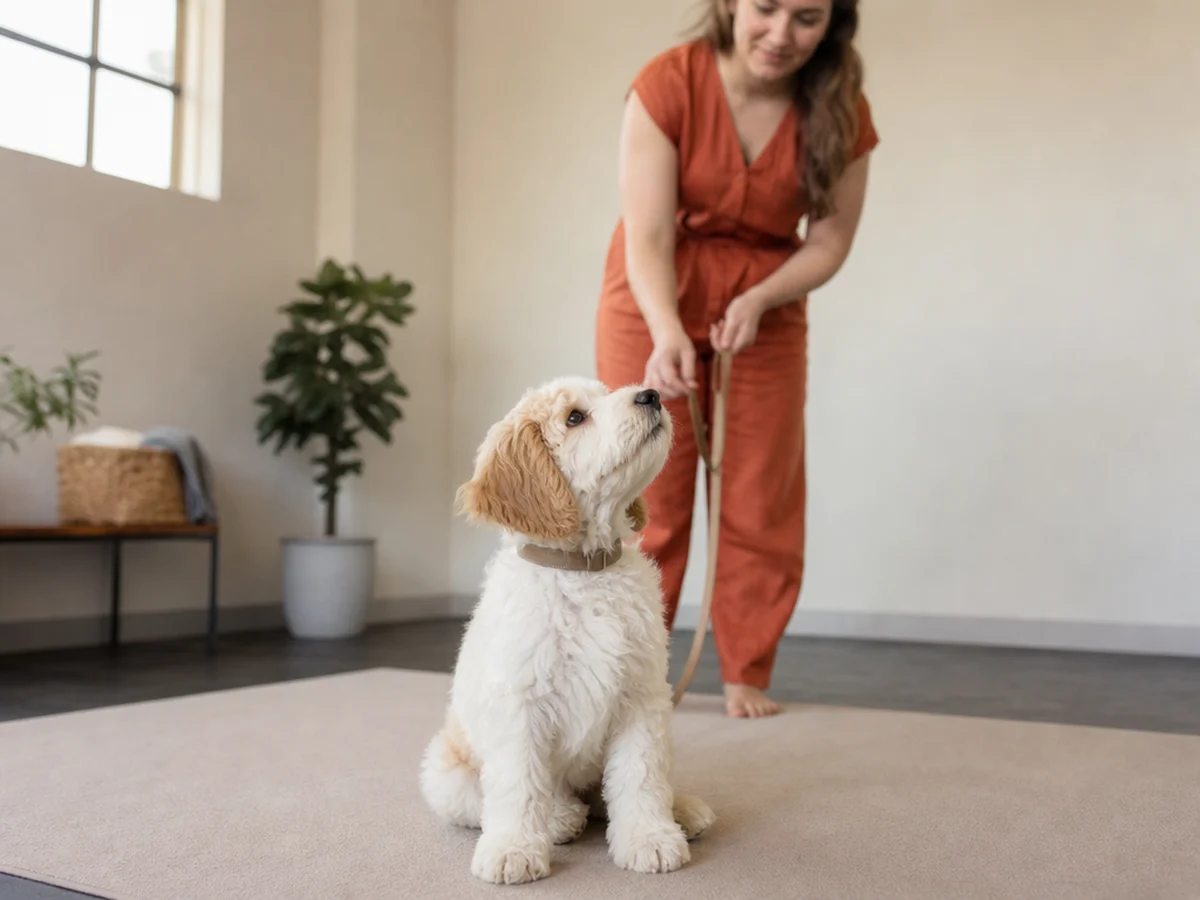
Begin With a Known Response
An open palm near the nose can provide a familiar question. Mark investigation or contact, remove the hand, and reward from the other hand. If the puppy does not approach, move closer or reward a small lean. Do not tap the nose.
Add a verbal cue only after contact is predictable. Then shift the hand a few inches left, right, higher, or lower while keeping the puppy’s feet on the floor. A palm target can later guide position without pulling the body into place.
Battersea teaches a cue for turning and following the handler away from a trigger. Its U-turn guidance addresses reactive settings. This puppy target has a smaller purpose, which is cheerful following in an easy room rather than an emergency response.
Let a Prop Remain Optional
Place a broad paw target or soft toy on the floor before the puppy enters. Mark a glance or approach. The object should not move toward the dog, and food should not pull the puppy across visible hesitation. Curiosity is enough to begin.
For a paw target, mark a weight shift before expecting contact. When one paw lands, reward and release. Make the target smaller only after the action is easy. Do not change size and location together, because two changes obscure what the puppy understood.
For a toy, reward a nose touch or brief mouth contact. Lifting comes later if the puppy chooses it. The Golden Retriever parent performs many kinds of work, and Poodle trainability supported entertainment roles, but neither parent description guarantees that this puppy will retrieve.
Keep hands away from the puppy’s legs. Physical placement can create discomfort and teaches less than voluntary movement. Cooperative nail care is a separate training project, and a trick session should never disguise restraint.
The Working Minute of Goldendoodle Puppy Training
After an easy opening, select one feature to develop. The feature may be distance, direction, object contact, or duration. Keep the rest familiar. One clear change lets the puppy solve a question rather than absorb several new demands at once.
Distance Can Grow Without Speed
Move the palm a few inches and reward one step toward it. Over several sessions, the target may guide a broad curve around a stable object. Complete only part of the path at first. The puppy should travel with loose balance, not race after the hand.
A full spin is optional. If used, guide one wide curve and practice directions separately. Stop when one side looks awkward or the puppy resists it. Ask a veterinarian about a new movement difference rather than drilling the less comfortable direction.
A broad object route provides another choice. Reward the puppy for following partway around a landmark, then return to the start. The route asks for spatial problem solving without repeated rotation. Keep the object wide, stable, and free of sharp edges.
An Exchange Can End With the Toy Returned
When the puppy chooses to lift a soft toy, mark that moment and offer food near your body. Reward the release and return the toy when safe. The lesson is that approaching a person can preserve access, not that every pickup leads to permanent loss.
If the puppy carries the toy away, use a calm enclosed space and pay the first return toward you. Do not chase. The Goldendoodle fetch guide develops a longer retrieve chain when carrying and return are each ready.
A wide container may catch a toy during a familiar release, but cleanup is not a required destination. Place the container under the exchange point and reward the landing. Remove it if pickup or return weakens. The toy exchange remains useful by itself.
Movement Must Fit the Puppy
A low platform can support body awareness when it is broad, stable, and nonslip. Reward looking, one front paw, and then two. Keep the rear paws on the floor and release after each success. There is no reason to add height.
A wide leg pathway is another optional route. Stand with enough room and target the puppy through once, then reward ahead. Do not close your legs around the dog or lure repeated figure eights. Different puppy bodies need different spacing.
PDSA notes that activity needs differ and that some working breeds need substantial exercise. That broad guidance does not set a Goldendoodle puppy target. Tricks are mental practice within an age-appropriate plan, not a way to chase fatigue.
The Goldendoodle exercise circuit provides other small-space stations. Keep those activities separate when the puppy needs clarity. A trick session does not improve because every available game appears in one sequence.
The Stopping Minute in Puppy Training
End after one clear success or when the puppy’s return becomes slower. A release, a few pieces of food on the mat, water, and quiet recovery create a recognizable finish. The ability to leave training is part of learning.
ASPCA explains that food-based meal puzzles can provide mental stimulation. Part of a meal may reward a session, while the rest arrives without work. Ordinary nutrition and rest should never depend on trick performance.
Use a short repair card before the next session. Choose only the line that matches what happened.
- If attention scattered, remove a prop and return to a quieter opening.
- If the puppy rushed, shorten the path and deliver rewards at the finish position.
- If a toy caused distance, reward return without adding a container.
- If movement looked uneven, stop that game and seek veterinary guidance.
- If the puppy did not return after release, choose rest instead of another cue.
Keep regular veterinary care and discuss new movement reluctance, appetite change, or unusual fatigue. A reward-focused trainer can observe timing and setup when learning problems persist. Neither professional should be replaced by repeating a difficult version until the puppy complies.
Record the offered response, the single feature changed, and how the puppy left. Those three observations are enough. A long score sheet invites judgment, while a compact note makes tomorrow’s setup easier to reproduce.
The next trick should come from the easiest willing response, not from a predetermined branch. A puppy who seeks the palm can practice a longer approach. One who enjoys a toy can repeat the exchange. Another may need only a calm mat finish.
That session shape remains stable even as the activity changes. Open with a known choice, ask one small question, and stop with clarity. The Goldendoodle puppy learns how to participate, while individual tricks stay optional tools rather than leaves that must all be collected.
 Exercise and jobsGoldendoodle Sports and Jobs That Fit the Individual Dog
 Training basicsHow Do You Train a Goldendoodle? A Reward-Based Guide for Owners
 Exercise and jobsHow Much Exercise Does a Goldendoodle Need? Plus Brain Games
