 Goldendoodle
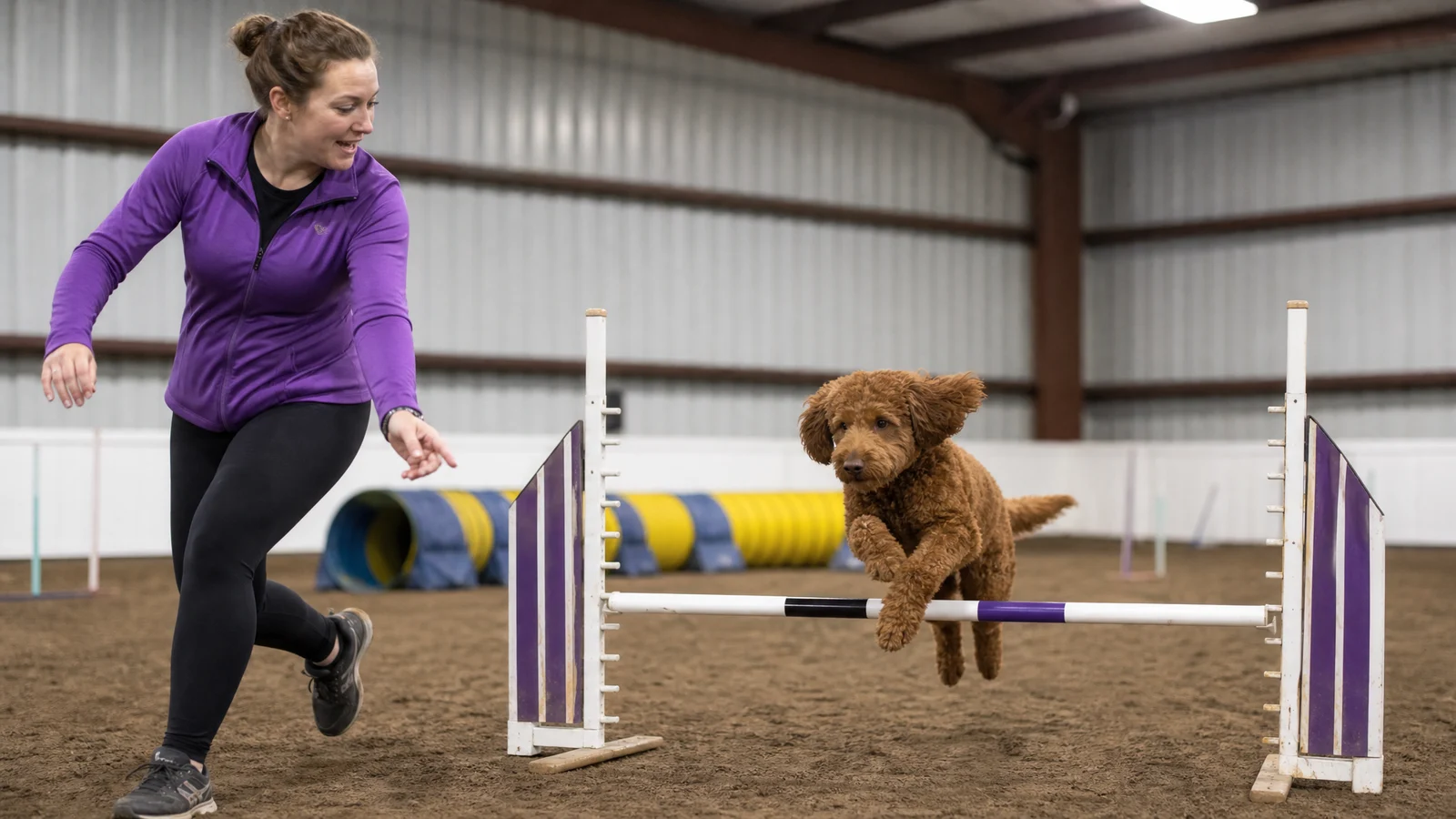
Goldendoodle sports should be chosen from the dog outward, not from an impressive list of parent-breed accomplishments inward. A Golden Retriever may work in demanding roles, and a Poodle may bring retrieving, scenting or athletic aptitude. Their cross may inherit some of those interests, a different combination or little enthusiasm for the activity you expected.
We treat the practical answer as an audition in an ordinary, manageable setting. Offer a low-pressure sample, reward voluntary engagement and watch how the Goldendoodle recovers after novelty. This guide compares nose work, agility foundations, retrieving games and structured assistance work without promising suitability. The best job is one the individual can perform comfortably, safely and repeatedly.
The Goldendoodle Dog Sports Audit
Start with behavior you can observe now. Does the dog search carefully, chase moving objects, enjoy body-position games or prefer close cooperation? Interest at home is only a clue, but it helps you choose the first audition without assuming that trainability means universal enjoyment.
Also notice what interrupts participation. Noise, unfamiliar flooring, nearby dogs and rapid handling can change the same learner. An activity can appear suitable on paper yet be a poor match in the available class environment, while a quieter activity gives the dog room to think.
Score Recovery Alongside Excitement
Initial excitement is not the whole audition. Watch whether the Goldendoodle can take a reward, respond to a familiar cue and rest after the sample. A dog who becomes progressively frantic may need a simpler setup or a different outlet, even when they appear eager.
Use the broader Goldendoodle exercise plan to account for class days. Learning in a novel setting adds mental load, so harder sport practice may call for an easier remainder of the day.
Nose Work as a Goldendoodle Job
Nose work is a useful first audition because the beginning can be quiet and simple. Best Friends explains that K9 Nose Work starts with a dog searching for a favorite toy or treat hidden among boxes, indoors or outside. That introductory search reveals persistence without requiring speed.
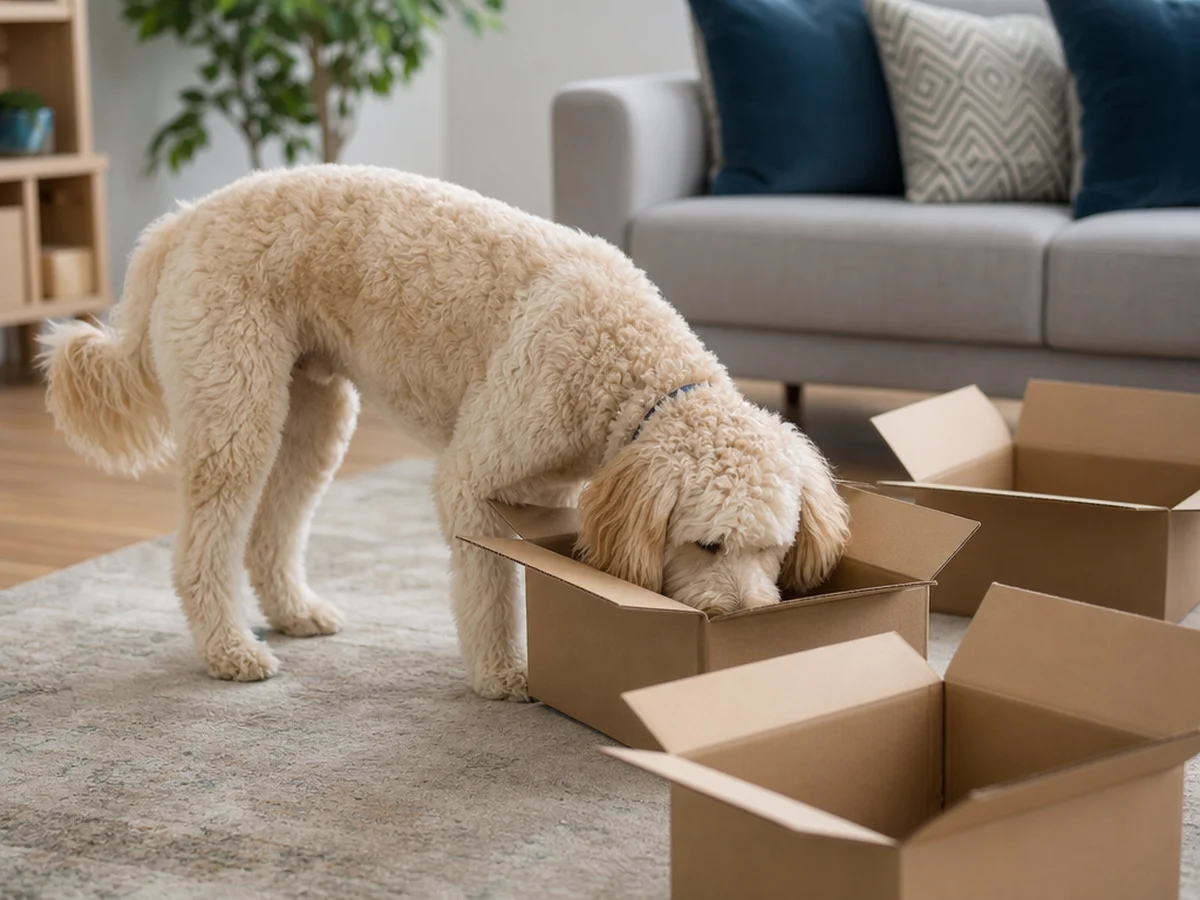
Set out stable open boxes and let the dog see food placed in one. Release them to investigate, then reward the find. Avoid steering the nose with your hand or repeatedly pointing, since the purpose is to learn whether independent searching is rewarding.
Advance Only One Search Feature
When the visible find is easy, change either the number of boxes, the hiding position or the room. Do not change all three together. The dog should still understand that their own search produces the reward.
A Goldendoodle who disengages may need an easier hide, more valuable food or a quieter space. Walking away is information, not defiance. End the audition while the dog can still make a successful choice.
Decide Whether the Job Fits
A promising nose-work candidate returns to the search area willingly and works without escalating into frantic grabbing. They can pause, reset and try again. A dog who mainly wants to shred boxes can still enjoy other scent games, but that setup is not yet showing careful search behavior.
Goldendoodle Dog Sports Without Speed
Agility foundations begin with body awareness, focus and confidence around simple equipment. They do not require sending a new dog over full-height obstacles. Use floor targets, wide pathways and movement around an object to see whether the Goldendoodle enjoys following cues with their body.
PDSA recommends choosing an instructor who uses positive methods, understands individual needs and works at a pace that suits dog and handler. Those criteria matter more than a fast demonstration. Review a class before enrolling and ask how the instructor adapts agility training.
Try a Ground-Level Pattern
Place two stable targets on the floor and reward the dog for moving between them with you. Add a wide curve around a cone only after the path is comfortable. This tests cooperation and spatial awareness without impact or pressure.
Keep the surface nonslip and the route open. Stop if the dog loses footing, avoids the target or becomes too excited to follow a simple line. A veterinarian should advise on physical suitability when health, growth or mobility raises a question.
Assistance Work and Enrichment Jobs
The word job covers very different standards. Carrying a toy to a basket is an enrichment job that gives a household dog a useful routine. Service work is disability-related task work with demanding public behavior requirements, and interest in tricks or retrieving does not establish suitability.
The AVMA explains that service work depends on individualized training for actions that mitigate a handler's disability. Its role definitions distinguish service animals from emotional support and therapy animals. A Goldendoodle is not a service dog merely because of breed, affection or manners.
Public Work Requires More Than Cues
PetMD quotes a trainer who emphasizes quiet attention to the handler, acceptance of many environments and steadiness around unexpected events. Those qualities make service work much harder than teaching a task in a living room. Individual evaluation and ethical training are essential.
Do not push a worried, distracted or environmentally sensitive dog toward public assistance work. A different enrichment job can still be valuable. Sorting toys, finding a named object or settling on a mat offers purpose without claiming access rights or disability-mitigation training.
- Choose a household job with a clear start, finish and reward.
- Keep the task voluntary and reduce difficulty when the dog hesitates.
- Do not represent enrichment, therapy visiting or emotional support as service work.
- Seek qualified, role-specific guidance before pursuing disability-related task training.
Goldendoodle Dog Sports Compared
Use a comparison only after the dog has sampled foundations. The matrix is not a breed prediction. It directs attention to the motivation and environment each activity asks for, then gives you a low-pressure first test.
| Activity | Motivation to Watch | First Audition | Reason to Pause |
|---|---|---|---|
| Nose work | Independent searching | Food in one open box | Frantic grabbing replaces searching |
| Agility foundations | Following body cues | Two floor targets and a wide curve | Uncertain footing or equipment avoidance |
| Retrieving games | Pickup, return and trade | One easy roll on land | Guarding or repeated runaway chases |
| Trick routines | Offering small learned actions | Touch, mat and one object cue | Loss of focus after rapid repetitions |
| Household jobs | Predictable cooperation | Carry one toy to an open basket | The task creates conflict over objects |
Retrieving interest is a possible parent influence, never a guarantee. The Goldendoodle training guide separates pickup, return and release before introducing water. That sequence is a better audition than throwing repeatedly and hoping instinct completes the chain.
Trick routines suit dogs who enjoy brief learning exchanges. The Goldendoodle puppy training progression can also serve adult beginners when the steps are adjusted. A mature dog does not need to skip foundation skills.
Run the Same Audition Twice
One sample can be distorted by novelty. Repeat the easy version on another ordinary day before deciding that the activity fits or fails. Keep the environment and reward familiar enough that the second result reflects the task rather than a completely new situation.
Compare approach, engagement and recovery, not speed. A dog who returns willingly and works more calmly on the second sample may be learning the setup. A dog who withdraws both times deserves a different option instead of increased pressure.
Keep a Noncompetitive Version
Every sport audition can leave behind a home game. Box searches can remain informal scent enrichment, and floor targets can remain body-awareness practice. Competition is optional. The activity still has value when its scale suits the Goldendoodle and the household.
A home version also provides continuity when classes pause. Preserve the same cues and reward pattern, while lowering environmental difficulty. This keeps the job recognizable without recreating a busy venue in the living room.
Goldendoodle Dog Sports Begin Off Course
A class becomes easier when the Goldendoodle can orient to the handler, take a reward and move away from a distraction. Practice those skills in ordinary settings before adding unfamiliar dogs and equipment. Foundation work protects the sport from becoming a weekly struggle for attention.
Teach a release cue so the dog knows when work has ended. Reward calm waiting between turns, since many sports involve more waiting than the highlight reel suggests. A dog who can recover between short efforts is often better prepared than one who performs a flashy behavior while over-aroused.
Interview the Instructor
Ask how rewards are used, how dogs are spaced and what happens when a learner declines an exercise. Look for adaptations rather than pressure. A positive instructor should be able to explain a smaller step without blaming the dog.
Observe whether the physical setup fits your dog. Flooring, entry routes and visual barriers can decide whether the Goldendoodle has a fair opportunity to learn. Class quality includes the environment as well as the lesson plan.
Prepare a Simple Class Kit
Bring familiar rewards, water and equipment appropriate to the venue. Include a mat if the class uses rest stations. Do not add an unfamiliar toy, new food and new gear all at once when the setting is already novel.
- Use rewards the dog can take and recover from in that environment.
- Give the dog enough space to remain able to orient and respond.
- Leave early when fatigue or distress replaces useful learning.
A Sustainable Goldendoodle Job
Rank the auditions by three measures: voluntary return to the activity, ability to learn within it and recovery afterward. The winner does not have to be the most athletic choice. A quieter job practiced consistently can provide more value than an exciting sport the dog cannot sustain.
Write the three leading options in order and name the evidence for each choice. Perhaps one produced focused searching, another supported easy movement and the third remained enjoyable only at home. That ranking prevents a fashionable activity from outrunning what the dog actually showed.
Recheck the order after several calm practices. Interest may grow when the rules become familiar, or fade when novelty disappears. Either result is useful because the selection stays responsive rather than becoming an identity the Goldendoodle must fulfill.
Parent-breed history can suggest what to sample, but it cannot select for you. Keep regular veterinary visits and seek guidance on physical suitability before demanding activities. For behavior concerns, use a training professional who uses rewards and can observe the dog in the actual setting.
Choose one main activity, one easy home version and one recovery routine. Revisit the choice when the Goldendoodle's age, health or enthusiasm changes. A fitting job makes the dog more available for the rest of life. It does not ask them to prove a breed story.
 Training basicsHow Do You Train a Goldendoodle? A Reward-Based Guide for Owners
 Exercise and jobsHow Much Exercise Does a Goldendoodle Need? Plus Brain Games
 Training basicsHow to Potty Train a Goldendoodle Puppy Without the Setbacks
