 Goldendoodle
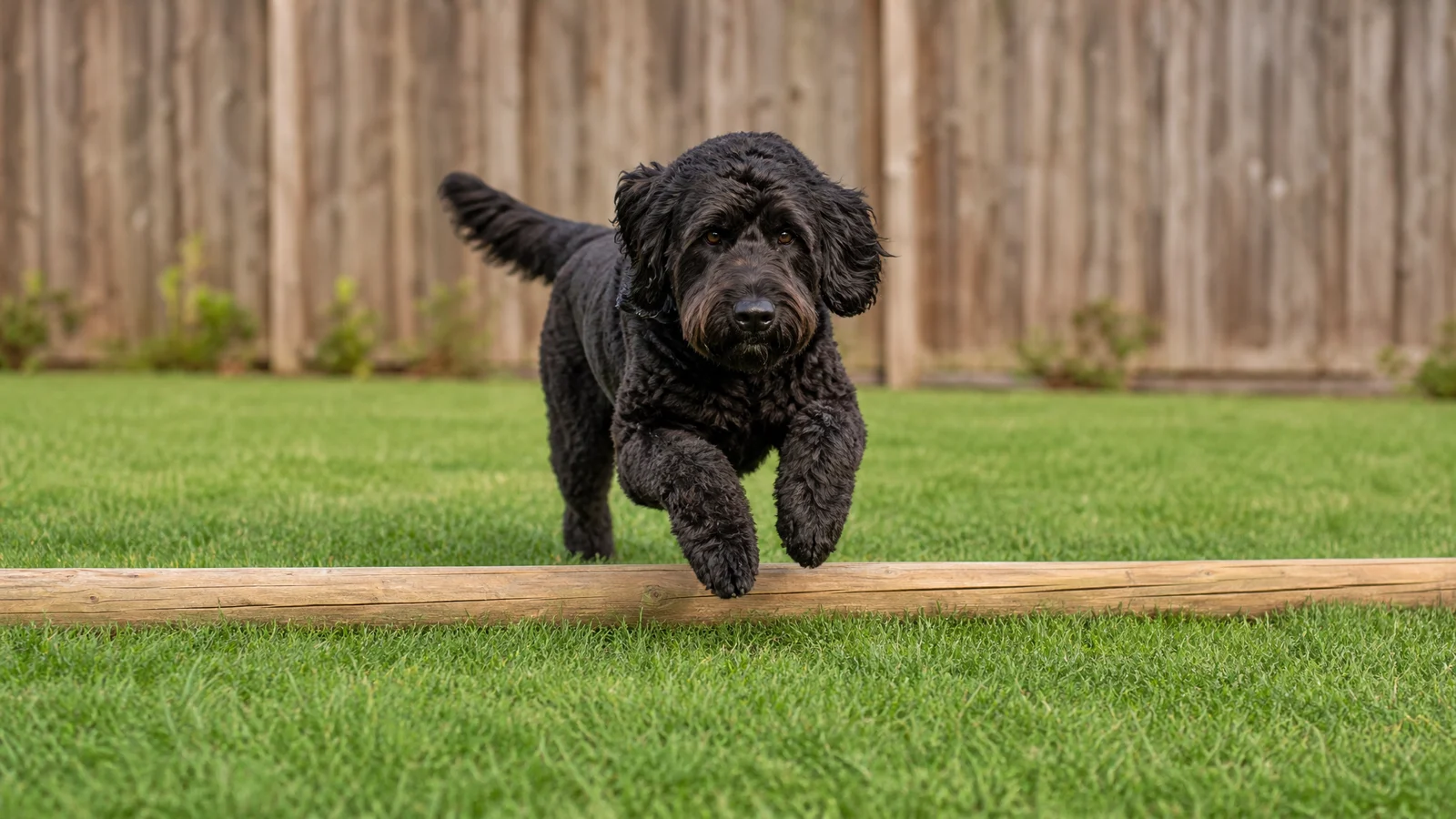
The first Goldendoodle jump you teach is a hop over a pole that sits close to the floor. For most dogs it is also the best version of the trick, and height can wait or stay out of the picture entirely.
Goldendoodles vary a good deal in size and build, and a bouncy, eager dog will happily try things their body has not been conditioned for. A low pole lets you teach everything that matters, a clear path, a cue and a reward on the far side, while every crossing stays small. That is also why the trick suits a dog who gets carried away.
Below you will find how to judge readiness, the four stages that build the trick, and fixes for the snags that turn up along the way. None of it needs equipment beyond a broomstick and a few small treats.
A Goldendoodle Agility Jump Starts on the Floor
In this lesson, a jump means your Goldendoodle chooses to cross a low pole on cue and finds a treat waiting on the far side. It is not a leap over a fence, a bar raised for show or the paws-on-shoulders welcome we cover in our guide to Goldendoodle greeting manners.
Keeping the target this small is what makes four clean stages possible, because each stage changes exactly one thing: the pole's height, the lure or the word. Goldendoodles often bring the eager, playful streak of their parent breeds to this work, which makes treats and games easy motivators. We see that same bounce turn into hurrying, though, so the plan builds slowness in from the first step.
Is Your Dog Ready to Jump?
Before any pole comes out, your dog's body gets a vote, and a young Goldendoodle's vote is usually to wait. It is also recommended, in PDSA's agility guidance, that dogs do not jump until they are fully grown, usually around a year to eighteen months. Because agility puts pressure on joints, heart and breathing, it is best to discuss any medical concerns with your vet before starting.
For an adult, watch ordinary movement first. An easy, even stride on walks and in play is what you want, and anything stiff, reluctant or unusual is a reason to hold off and ask. Mention the new trick at your dog's next regular vet visit too, especially for a large or long-bodied Goldendoodle.
Puppies have a longer road, and our Goldendoodle puppy training timeline lays out what suits each age, so the jump lesson can wait without anything sitting idle.
Footing and a Pole That Falls
Agility is not a high-jump contest, a point the AKC's advice on practicing agility at home backs with a simple rule: what a dog can jump and what they should jump are two different things. Its setup is plain: a broomstick or similar pole balanced on two low objects like books or flower pots, a surface that is not slippery and a pole that falls if your dog hits it. Gather these before the first session:
- A light pole such as a broomstick, resting on two low supports so that it drops if your dog bumps it.
- A floor with real grip, because a skid at the takeoff or the landing is the quickest way to put a dog off the trick.
- Clear space for a straight approach and a few steps beyond the pole, so the landing is never crowded.
- Small, soft treats your dog loves and a quiet room without other pets or visitors, because a dog who is busy noticing the room cannot learn the pole.
With those four things in place, the stages below can run in short sessions, and you will not need to rescue a lesson that went wrong because of the room. A few minutes of setup now saves a great many muddled sessions later.
Four Stages From Floor Walk to Cued Jump
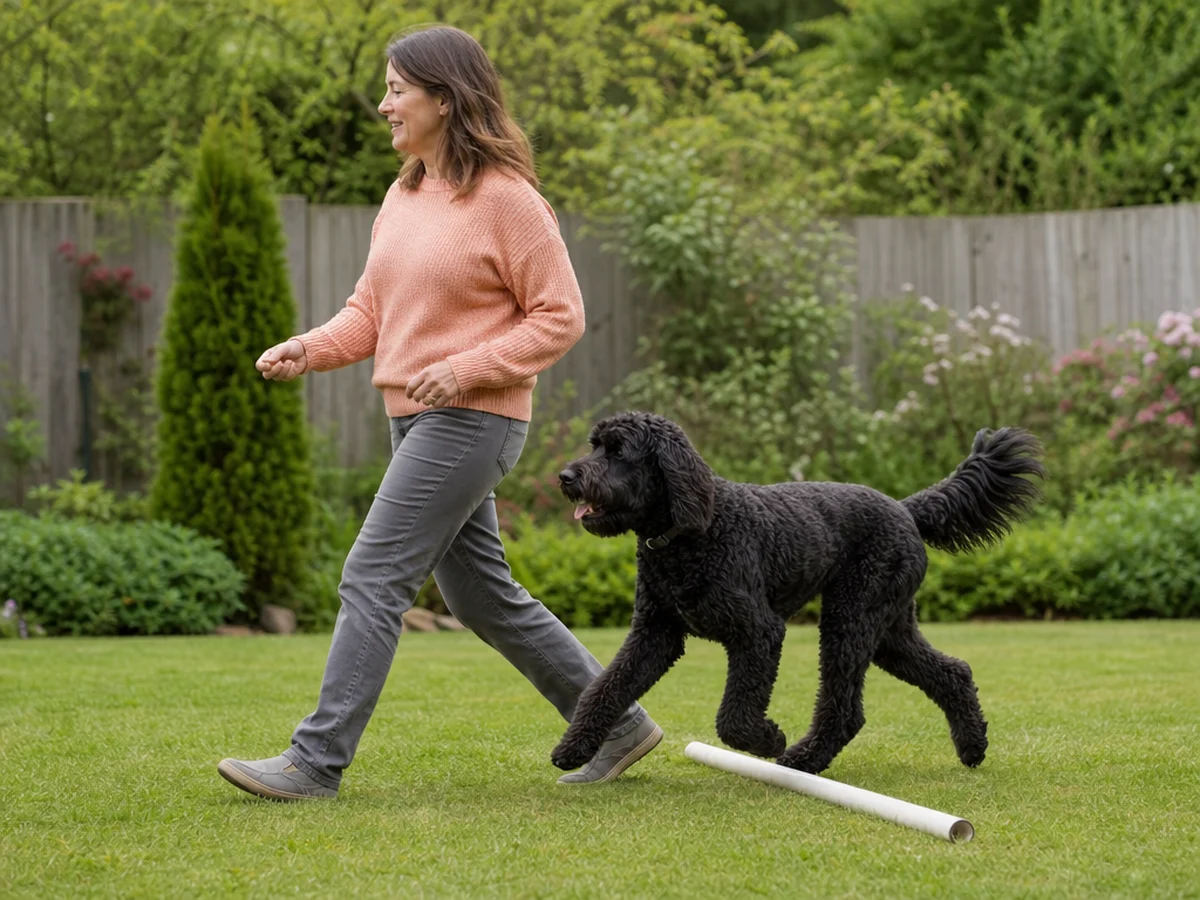
With a ready dog and a forgiving setup, the lesson comes down to four stages, and each one should feel almost boring before you start the next. Moving on is a judgment about smoothness, not a count: when your dog crosses easily several times in a row without hesitation, the next stage is fair.
Walking Over a Pole on the Floor
Lay the pole flat on the floor, because a pole nobody has to jump is the safest way to teach what the pole means. Your dog's first job is simply to walk across it toward a reward. Work through it like this, with your dog standing beside you:
- Show a treat at your dog's nose, so their attention is on your hand and not on the pole.
- Draw the treat low and slowly across the pole, so your dog follows it over in a straight line.
- Say your marker word as the last paw clears the pole, or click if you use a clicker, so the sound tells your dog exactly what earned the treat.
- Pay on the far side of the pole, which teaches that the far side is where good things happen.
- Walk back around, reset and repeat from the same side until the crossing looks easy.
If your dog circles the end of the pole instead, set it across a hallway or between two pieces of furniture so the only way to the treat is over. Once the crossing is smooth, you have taught the whole path, and everything after this adjusts how high the pole sits and how your dog is cued.
Lifting the Pole Just Off the Ground
Rest the pole on its two low supports so it sits just clear of the floor, and repeat the same lure and pay. At this height your dog barely changes their stride, which is the point: the idea of lifting paws over a pole arrives without any leap. Keep it at a height your dog could simply walk across, because a taller pole adds nothing a Goldendoodle needs for this trick.
Move up only when the floor-level crossing feels easy, and expect a few relaxed repeats at the new height before your dog looks settled. If the pole gets knocked, the design is working: it drops, nobody is hurt and you simply reset it.
Fading the Lure to an Empty Hand
A treat that leads your dog across every time becomes part of the picture, so now you shrink it. The same shrinking appears in the SF SPCA's simple tricks guide, where the lure sits a little farther back and the hand movements get smaller as the dog starts to understand. Follow these steps from the same starting spot:
- Hold your lure hand empty and sweep it across the pole exactly as before, with a treat hidden in your other hand behind your back.
- Mark the crossing and pay from the other hand on the far side, so the empty hand becomes a signal instead of a bribe.
- Make the sweep smaller each time your dog crosses easily, until it is little more than a point toward the far side.
- Stand a little farther from the pole and signal from there, since a dog who crosses on a distant point no longer needs your hand beside the pole.
If your dog stops at the pole, make the signal a little bigger for the next few tries and pay generously for any step toward the far side. Smaller is the goal, but never at the price of a confused dog.
Teach a Goldendoodle to Jump on Command
Once your dog crosses from a small signal, attach a word. Choose one short word, say it once in a calm voice just before your hand moves, and pay the crossing as usual. Repeating the word does not help, because it is meant to predict the signal and not to nag.
Next, test whether the word is doing the work: say it with your hand still, and pay any crossing. When that holds, move to a new room, approach from the other side and try a second pole, keeping every pole low. Each change is a small new question for your dog, and if they stall in a new room, ease back in with the signal for a few repeats.
When a Goldendoodle Jump Stalls
Even a well-built plan meets a few predictable snags, and each one points to a stage that needs a smaller step. A dog who walks around the pole is telling you that the way over is not yet the easiest way. Block the sidestep with a hallway or furniture, lay the pole against a wall and place the treat directly beyond it, so the shortest path is over the top.
A Goldendoodle who rushes, skids or leaps is often following the lure too fast or facing a pole that is too tall. Slow your hand, lower the pole to walking level and pay for a calm trot, since a relaxed crossing is the one you want to repeat.
Hesitation at the pole, whether a stare or a step backward, means the last change was too big. Lower the pole, pay for looking at it, then for one paw near it, and build toward the crossing in smaller pieces than before. A dog who seems sore, stiff or reluctant to move at all needs your vet, not a different technique.
Loose Ends in Jump Practice
The four stages leave a few practical gaps. These short answers fill them, one at a time.
Is a class better than practicing at home?
Home practice is enough for this trick, and a class is a bonus rather than a requirement. If you look for one, choose an instructor who uses rewards and takes your Goldendoodle's comfort seriously, and see our Goldendoodle sports and jobs guide for what agility foundations look like.
Will jump practice make furniture jumping worse?
The word is taught for one object in one setting, so it should not turn into permission for the couch or the car. Keep your usual household rules exactly as they are, and a pole in the living room will not change them.
Do Minis and Standards Need Different Poles?
The stages stay the same, but the supports should suit the dog's legs. Walking level means a height your dog can step across without changing their stride, so a Mini's pole sits closer to the floor than a larger dog's. Light poles and grippy floors matter at every size.
What a Low Pole Teaches Your Goldendoodle
By the time the word works, your Goldendoodle has learned something wider than one trick. A strange object lying across the floor stopped being a puzzle and became an ordinary thing to look at, step over and leave behind.
That calm curiosity about unusual shapes is what stays with a dog long after the height question is settled, which is why we keep the pole low even for a Goldendoodle who clears it easily. Over the years your Goldendoodle will need far more than a pole crossing, and our e-book maps all of it clearly and in depth. Leave your email on this site and a copy is on its way to you, without cost.
 Training basicsAre Goldendoodles Easy to Train? Smart or Stubborn
 Training basicsAre Goldendoodles Good With Kids?
 Training basicsIs a Goldendoodle the Right Dog for You? What Training Takes
