 Goldendoodle
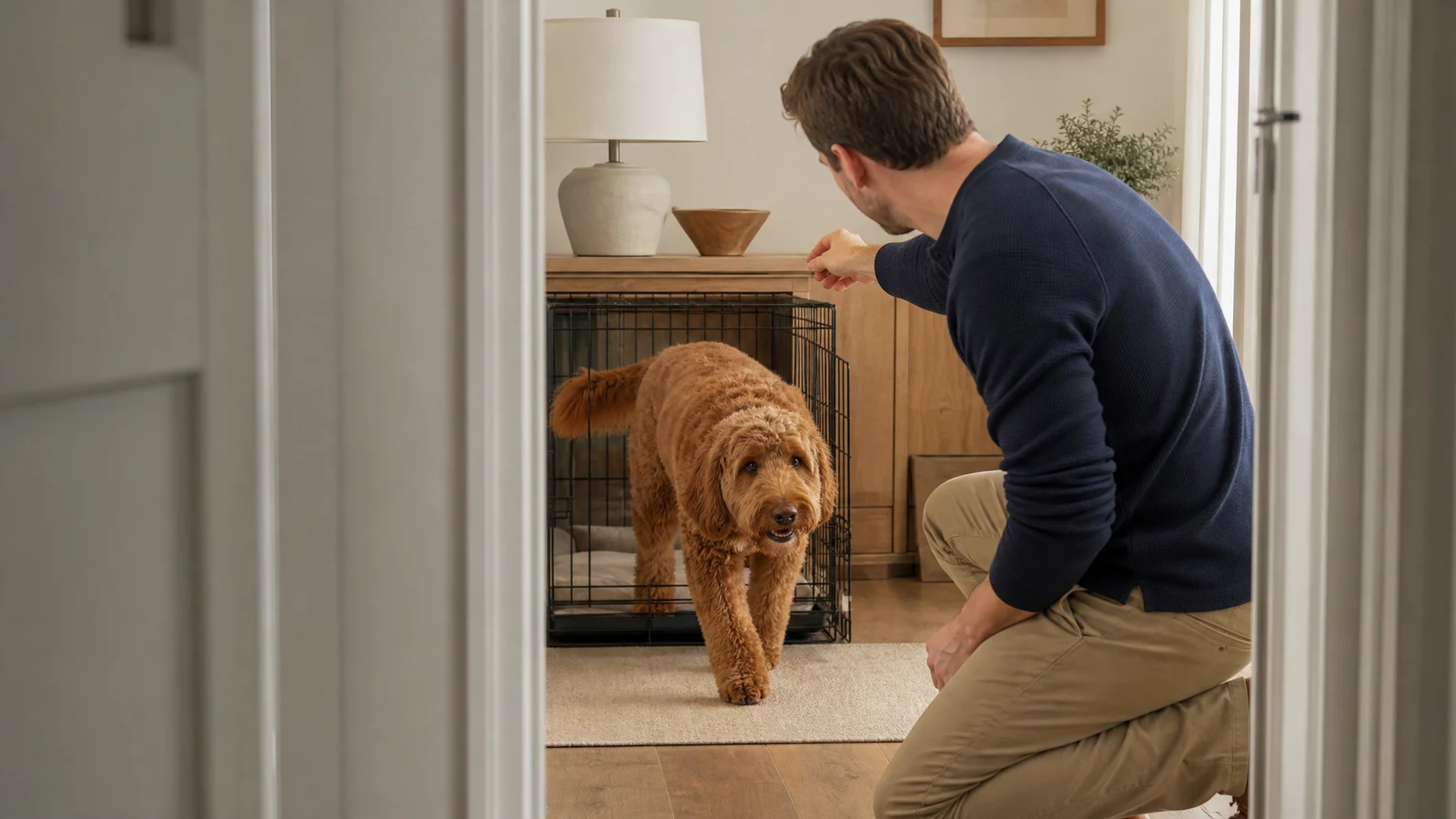
Some Goldendoodles curl up in the crate and nap while their owners run errands. Others panic at the click of the latch, shaking the crate or refusing treats, and a few cannot rest unless their person is in the next room, even at home. Same breed, same crate, very different dogs.
That spread matters because both parent breeds rate 5 of 5 for affection with family, so strong attachment is a fair thing to expect. Handled badly, the crate becomes the place where a worried dog practices panic. Handled well, it becomes a calm den and the first step toward comfortable alone time. We have trained this breed for many years, and pace decides almost everything.
Read on for how the crate fits a people-loving dog, why gradual practice beats waiting out the crying, what puppies and adults each manage, how to read crate barking, and one exercise to try today.
Goldendoodle and Labradoodle Crate Training Compared
Nobody can hand you a tidy crate ruling for a Goldendoodle, so we start with what the parent breeds tell us. The Golden Retriever rates 1 of 5 for barking and the Poodle 4 of 5, which means a cross could land anywhere on that scale. That is why we treat alone-time barking as something to train gradually with rewards rather than something to predict.
Both parent breeds rate 5 of 5 for affection with family, the very top of the scale. A cross may inherit that, which is why strong attachment is a reasonable expectation.
Barking is where the parents split. The Golden Retriever rates 1 of 5 and the Poodle rates 4. A Goldendoodle could land anywhere between, so we treat alone-time barking as something to train gradually with rewards, not as a trait to assume or dismiss.
Distress Does Not Always Make Noise
Because attachment runs strong, the signs of struggle vary more than most owners expect. Barking and howling are the obvious ones, but owners also report quieter versions:
- Dogs who cannot rest unless their person is nearby, even when nobody has left the house.
- Dogs who go silent, lying by the door, refusing treats or seeming sad after the owner leaves.
- Dogs who will not eat when the owner is out of the room, with appetite staying off even after the owner returns.
- Dogs who react to departure cues such as putting on shoes, and some who seem anxious from the first day at home.
A quiet crate is therefore not proof of a calm dog.
Does a People-Loving Goldendoodle Really Need Crate Training?
Plenty of owners describe a Goldendoodle who follows them from room to room and sighs outside the bathroom door. It is fair to ask whether shutting that dog in a box makes sense at all. Our answer is that it depends on what the crate means to the dog, and you find out by watching, not by assuming.
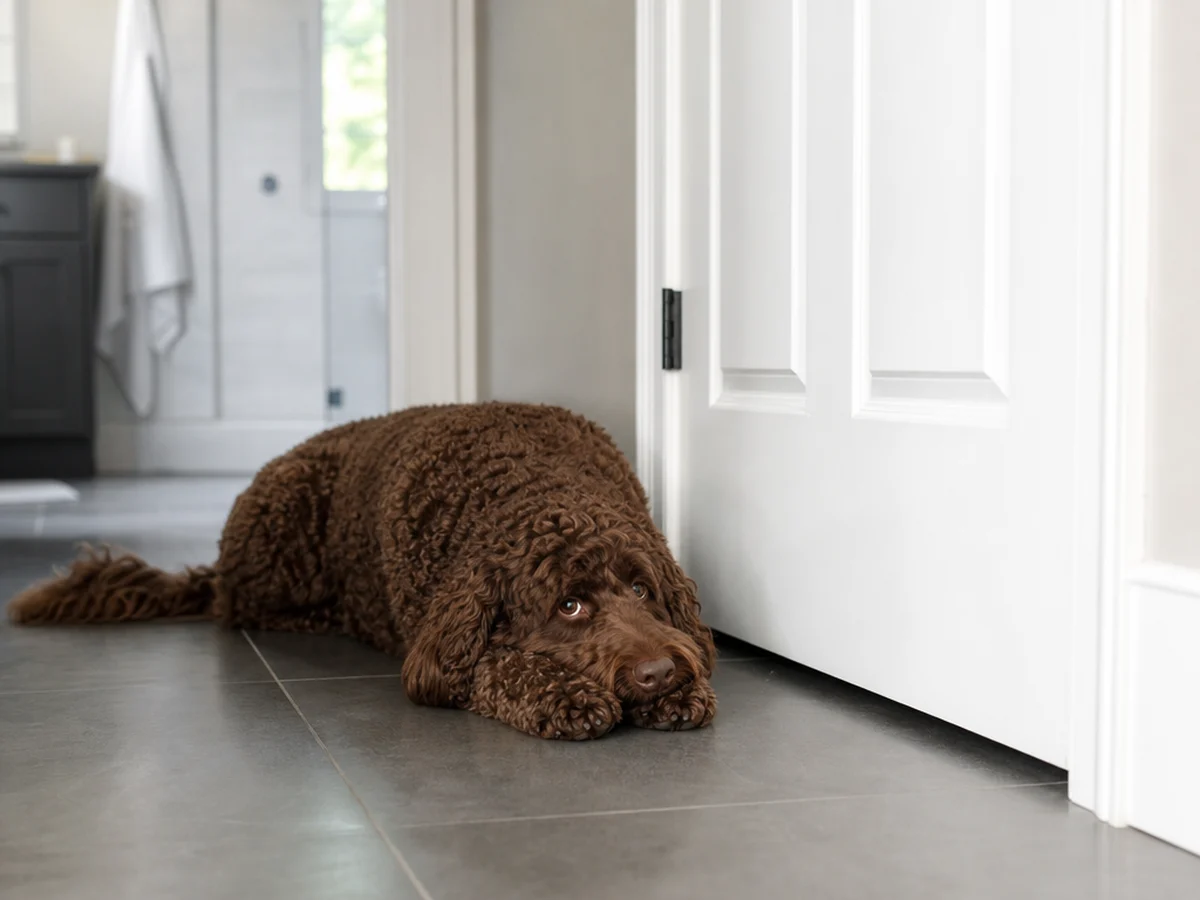
Owners report both outcomes. For some dogs the crate makes being alone easier: they cry briefly, then nap. For others the crate itself is the problem. They hate it, shake it, refuse to go in, and do better once out. Free roaming splits the same way. Some dogs are calm loose in the house after house training, while others panic loose and settle only in the crate.
So the crate is a tool, not a requirement. The popular claim that every dog secretly wants a den deserves some skepticism. A den is something your dog decides on, one treat at a time.
Build the Den Slowly
Introducing the crate with treats at your dog's pace can take minutes or days, and sessions of about three minutes are plenty. Keep the crate in a room where the family spends time, and leave the door open between sessions.
Try naps in the crate, in another room, while you are home. That keeps the crate from becoming the signal that you are leaving. Covering the crate suits some dogs and bothers others, so watch your dog's reaction and drop it if they dislike it. A private space of their own has also helped clingy dogs.
A mat can do part of the job. Teaching a dog to go to a crate or mat and stay quiet until invited to greet is a kind answer to the doorway excitement that people-loving dogs find irresistible.
Cry-It-Out Versus Gradual Crate and Alone Time
The common advice is blunt: shut the door, ignore the noise, and the dog will learn. Owners of this breed report a messier picture. Dogs bark, howl, whine or cry for hours, and some stop eating, with appetite staying off even after the owner is back. For a dog who finds time alone hard, hours of crying is not learning. It is practice at panic.
The slower alternative suits attached dogs better. Decide on the final behavior, such as resting calmly while you are out of sight, and break it into small, rewarded steps marked with a click or a word like "yes." Some owners report that repeated short departures, stretched out slowly, led to improvement. It took a couple of weeks for some dogs and months for others.
Expect setbacks. A trip with a house sitter or an unexpected return home set progress back for some dogs, and some stay anxious into adulthood. Some owners, after months of work, come to see true anxiety rather than a behavior problem and pace the training to the dog. We agree with them.
A crate is not a cure either. When separation anxiety is the issue, a crate needs professional guidance behind it, so if panic is a possibility, talk with your vet or a certified behaviorist.
Small Comforts That Help Many Dogs
Comforts will not fix anxiety, but owners report they smooth the edges for many dogs, though not all:
- Calming sound such as music, a radio, TV or white noise, or a lavender diffuser. Some dogs stay unsettled anyway.
- Something that smells like you, such as a worn t-shirt, a teddy or a heartbeat toy.
- A stuffed frozen Kong, cheese, peanut butter or a dental chew handed over as you go.
- Another dog or a cat, which settled some dogs but not every dog.
Puppy Crate Training Hours Versus Adult Goldendoodle Settling
Reports of alone-time distress cover a wide range of ages, from 8-week-old puppies to an adult dog nearly 10 years old. That spread says something plain: a puppy is not guaranteed to grow out of it, and an adult is not past help.
The Puppy Stage
Puppies need short crate stretches and frequent trips outside. Early socialization for a Golden Retriever puppy runs from seven weeks to four months, and the same window suits a Goldendoodle, so fit brief, happy alone-time practice around those outings.
Crate details cause more accidents than owners expect. A puppy who is still being house trained should not have spare room in the crate, so size it to the dog and move to a larger one only once they are reliably clean. A dog who is already trained may do fine in a large crate. Some puppies pee on bedding, so owners go bare or use a thin washable pad. Repeat accidents in one spot stopped for some owners after vinegar or enzyme cleaning.
Some owners also limit the puppy's indoor space, using a small kitchen pen with toys or pee pads as backup until the puppy reliably asks to go out. Our guide to potty training a Goldendoodle puppy covers the rest.
The Adult Stage
A reliably house trained adult can handle more space and more freedom, but earn it in steps. Owners report opposite results from free roaming, so test with short absences and a camera before you stretch them.
Exercise matters here. Poodles are very active and need good exercise every day, and both parents rate high for mental stimulation, so a cross may need brain work too. A dog who has walked, played and trained settles more easily. Some dogs do improve with age or habituation and get used to being home alone, but do not simply wait for it.
Is Crate Barking Protest or Panic?
Two Goldendoodles can bark for the same length of time and be in very different states. One is complaining that the party moved without them. The other is frightened. Barking alone cannot tell you which, especially in a cross whose parents sit at 1 and 4 for barking.
This comparison is a rough guide, and the right-hand column is the one that needs action:
| What you see | Likely protest | Likely panic |
|---|---|---|
| Sound | Whining or barking that fades, then quiet | Barking, howling or crying that keeps going, sometimes for hours |
| Body | Settles, lies down, often naps | Shakes or climbs at the crate, urinates on themselves, rubs the nose raw |
| Food | Takes the chew or treat after a short fuss | Refuses treats or food, with appetite off even after you return |
| Surroundings | Nothing damaged | Tears blankets, digs, claws at doors, chews cabinets or drywall |
| Quiet dogs | Relaxed by the door or in the crate | Lies by the door, seems sad, reacts to shoes and other departure cues |
Noisy or destructive dogs may be in real panic, not being difficult. Set up a phone or pet camera and watch the first stretch after you leave, because many dogs look fine at the door and struggle later.
Protest earns patience and a slower ladder. Panic earns a step back to the duration your dog managed calmly before, with a sitter or the dog coming along in the meantime. Keep up regular vet visits and mention what you see. If the crate seems to be the trigger, our guide to Goldendoodle behavior problems helps you look at the wider picture.
One Short Goldendoodle Absence to Practice Today
Open the crate door, drop a stuffed frozen Kong inside, put on your shoes, and walk out of sight for a few seconds. That is the whole exercise. It is small on purpose, because a dog this attached learns alone time in pieces.
- Start after a walk, some play and a short training session, so your dog is tired and ready to settle.
- Leave the crate door open with the chew inside, so the crate is a choice and not a trap.
- Walk out of sight, then come back before any fuss starts and keep the hello low-key.
- Repeat a few times, and stop on a repetition where your dog stayed relaxed.
- At the next session, stretch the absence only slightly, and if your dog tenses, return to the last easy length.
Progress looks dull at first: a dog who glances up, keeps chewing and settles. Owners report improvement from a couple of weeks to months, with setbacks after disruptions, so judge by the trend. Our complete guide to training a Goldendoodle covers the daily routines that support it.
Do it once today: crate door open, chew inside, out of sight for a few seconds, and back before your dog has time to worry.
 Exercise and jobsGoldendoodle Fetch and Water Play: A Troubleshooting Guide
 Puppy trainingGoldendoodle Puppy Training Timeline, 8 Weeks to 2 Years
 Exercise and jobsGoldendoodle Puppy Tricks: A Reward-Based Skill Tree
