 Goldendoodle
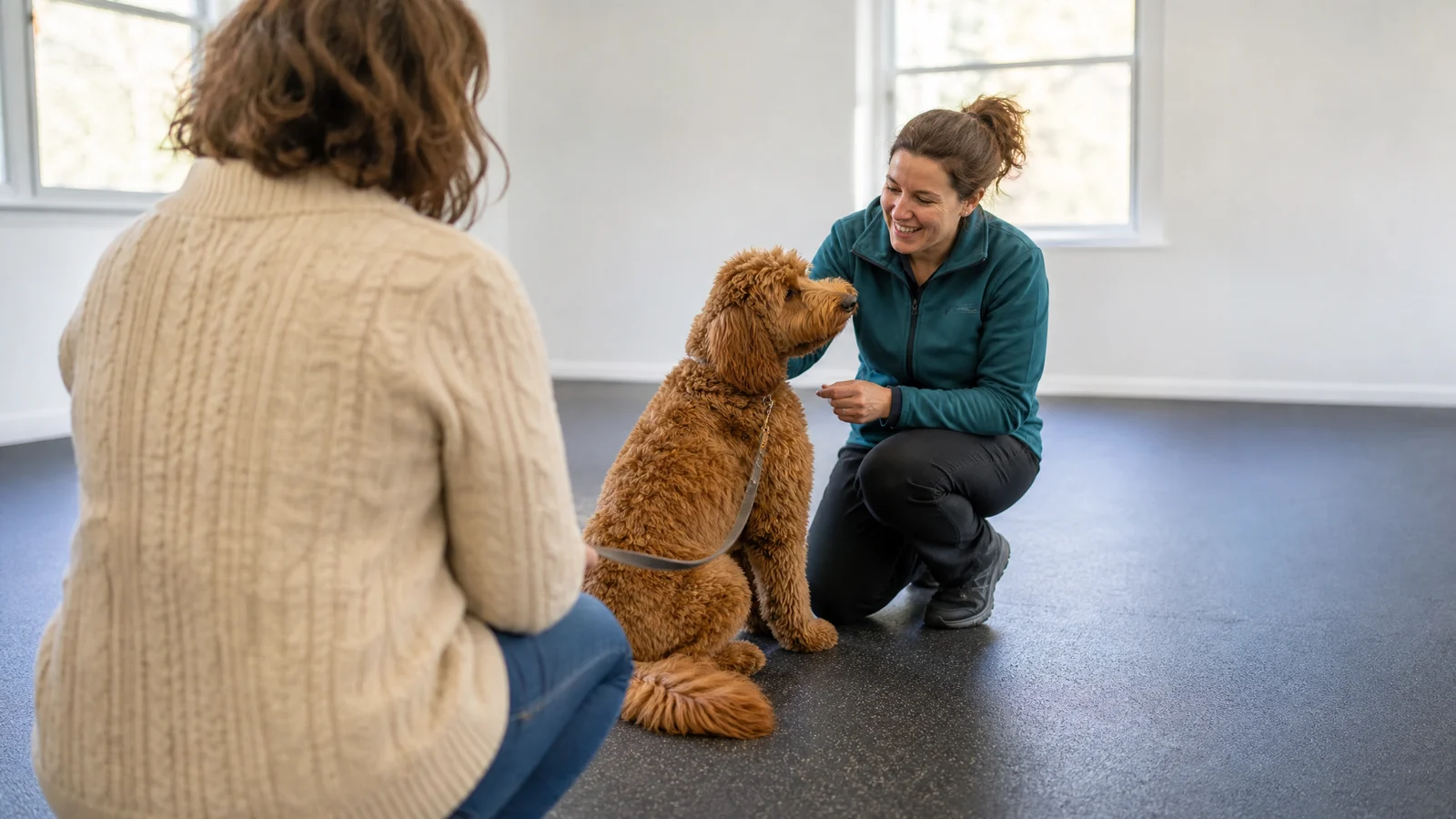
Goldendoodles often inherit a sociable streak from both parent breeds, so almost any trainer you meet will be greeted with a wagging tail and a bounce of welcome. That makes the wag a poor test, because a friendly dog will cheerfully follow someone whose methods you would never choose.
What you are really hiring is a person who can teach you, and that choice rests on things your dog cannot show you: how a candidate explains their teaching, what their title actually covers and how they handle an enthusiastic hello.
This guide walks through when to call, how to read titles, what reward-based teaching sounds like, what to watch in a first lesson and which format suits your goal, with a few loose ends answered near the end.
When a Friendly Dog Still Needs a Trainer
A dog who loves everyone rarely worries a trainer, so the trouble tends to hide inside the enthusiasm: the greeting that becomes a leap, the walk that becomes a tow toward every passerby, the cue that disappears the moment something more exciting shows up. Those habits come with bouncy, people-loving dogs, and they are exactly where a second pair of eyes helps.
Help is worth booking when a habit survives a plan you have followed steadily, when you want a skill taught faster than your own practice allows, or when you cannot tell whether your timing is part of the problem. A trainer is above all a coach for the human end of the leash, watching what you do with your hands, voice and treats and adjusting it.
Some situations belong somewhere else first. If your Goldendoodle's behavior changes suddenly, call the veterinarian before anyone else, because pain or illness can sit behind a new habit.
Mention smaller oddities at regular veterinary visits so they are on record. Before you call anyone, try the basics at home, because a trainer will want to hear what you have already tried. Our Goldendoodle training guide lays out a reward-based starting plan, and steady use of it gives a trainer something concrete to build on. Fear, guarding and aggression call for a different kind of professional, which the next section sorts out.
Reading Trainer Titles Before You Trust Them
Knowing what you want from a professional leaves the harder question of who is qualified to give it, and the label on a business card is only a starting point. Treat every title as a claim to check, not as proof.
Since dog training is not regulated, any trainer can describe their methods as kind or humane, so a simple screen helps: a guest author on the AVSAB site suggests picking a trainer who will use food to teach, because you can see for yourself whether that is happening. Play can be a fine reward too, but food is the easy one to check.
Treats are not the whole test, but they are an honest one. A trainer who pays your dog with something they value is teaching them what to do, not only what to avoid, and that is the direction you want lessons to run.
When the Problem Needs a Behaviorist
A few problems need more than a trainer. A behaviorist holds a graduate degree in animal behavior, or is a veterinarian mentored by a veterinary behaviorist. Separation anxiety, aggression of any kind, extreme fear and reactivity are the cases MSPCA-Angell's guide to choosing help places with one, after a veterinarian has ruled out a medical cause for any sudden change.
If your dog's trouble sits on that list, start with your veterinarian and ask for a referral instead of booking general lessons and hoping they help. A sound general trainer will say the same and will decline a case that is beyond what they can teach safely.
Asking What a Title Required
Titles are easier to judge once you ask what earned them. Ask who awards the title, what the holder had to show to get it, whether it needs renewing and what the trainer has done with dogs like yours. A trainer who answers easily and without defensiveness has given you something useful to weigh.
What Reward-Based Training Sounds Like on a First Call
With the titles read, the next filter is how the trainer talks about teaching, and a short call is usually enough to hear it. Ask them to walk you through a typical first lesson for a dog like yours, then listen for what your dog is taught to do.
That focus on what to do instead sits at the center of the least intrusive, minimally aversive standard that APDT International publishes, built around picking the gentlest strategy likely to succeed and leading with positive reinforcement.
What a Good Answer Contains
A reward-based answer sounds like a plan, not a promise, and it usually touches the same handful of points. Listen for these four as you talk.
- What your dog does instead: The trainer names the behavior they will teach in place of the problem, not only the behavior they want to stop.
- Rewards Your Dog Values: You hear about food, play and praise, and the trainer asks what your dog loves before choosing one.
- No gear meant to hurt or scare. Tools and handling that rely on pain, startle or fear never come up as an option, however the trainer words it.
- A trainer who knows their limits will say plainly when a problem belongs with a behaviorist or your veterinarian instead of stretching to cover it.
A candidate who can answer all four in a few sentences each is describing a real plan, and one who offers only reassurance is selling a result no one can promise.
Rewards Beyond the Treat Pouch
A Goldendoodle may be as motivated by your company as by a treat, because both parent breeds are known for wanting to work with their people. Praise, play and a quick game of tug can carry real weight in a lesson, so ask whether the trainer uses them alongside food. Consistency matters as much as the reward, since a cue asked the same way by everyone at home is the one that sticks.
Watching a Trainer Handle a Goldendoodle Who Loves Everyone
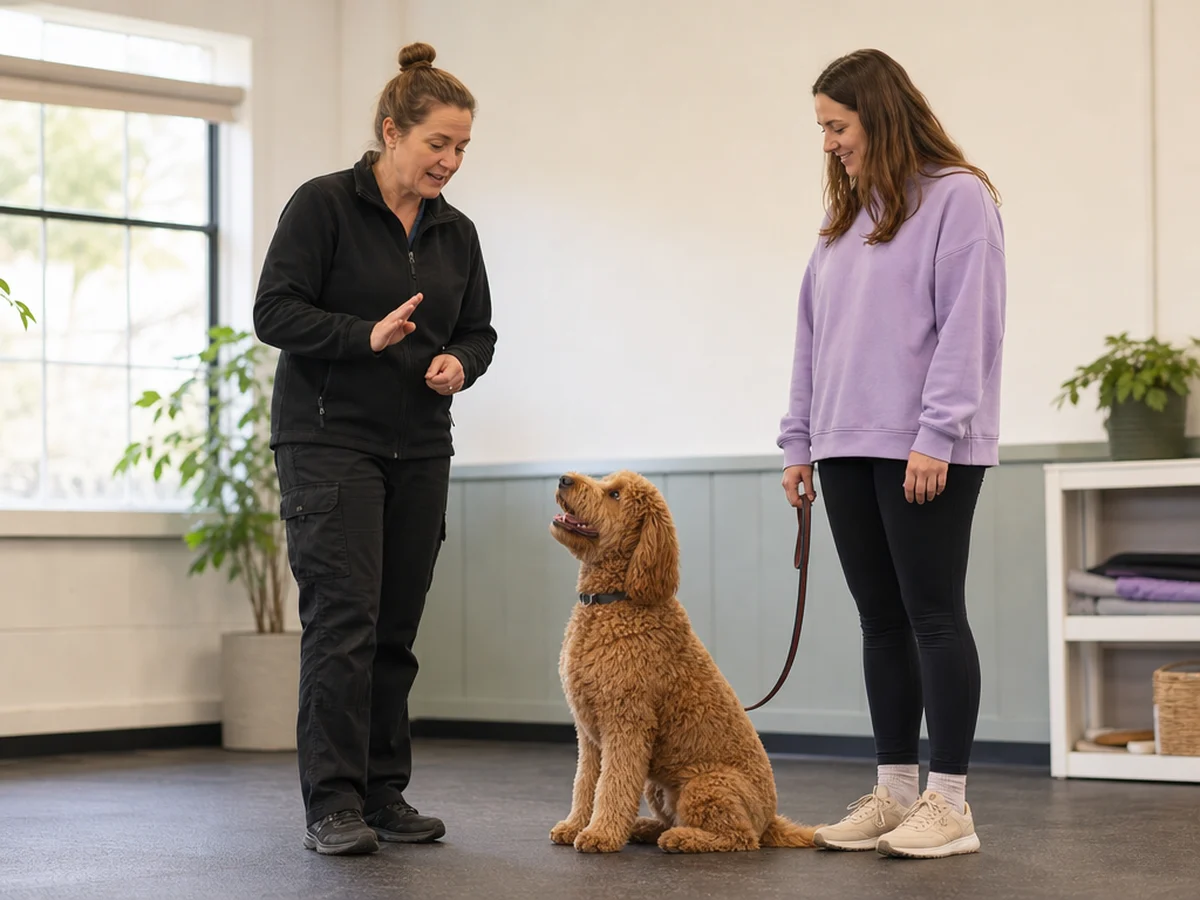
Phone answers earn a trainer a place on your shortlist, but a live lesson shows whether they belong there. Ask to watch a class or a session before you commit. The first thing we look for is how the trainer meets a dog who is thrilled to see them.
What to Notice While You Watch
The greeting makes the best opening scene, because a Goldendoodle's enthusiasm is where most lessons begin and where polite greetings are built. Watch how the trainer meets an excited dog, then work through the rest of this list as the lesson unfolds.
- The trainer stays calm and quiet during the hello and pays for four paws on the floor, instead of pushing, shouting or flapping their hands.
- Rewards arrive within a moment of the right behavior, so your dog can tell which choice earned them.
- When a dog gets something wrong, the trainer makes the task easier or resets the setup, and does not repeat it louder or harsher.
- The trainer hands you the leash and treats early and coaches your timing, because you are the one who will be there tomorrow.
- The dogs look relaxed and willing at the end, still interested in the trainer and not hanging back or turning away.
One lesson cannot show everything, yet these five points are visible in a single visit and are hard to stage. If two or three are missing, take that as your answer.
Before You Leave the Lesson
Stay a few minutes afterward and ask what a week of practice would look like for your dog, how progress gets measured and how you can reach the trainer between lessons. Specific answers, even modest ones, beat big promises, and they give you something to set beside the next candidate's.
Group, Private or Boarding Help for a Goldendoodle
Once a trainer has passed those tests, the last decision is the format, and the right one depends on what you want your Goldendoodle to learn and how much of the work you want to see. Each format has a typical job, and each asks something different of you.
Group Classes for Everyday Manners
A group class suits everyday skills such as sit, down, walking beside you and coming when called, and it gives a sociable dog practice staying focused near other dogs. That practice is the real work for a Goldendoodle, because a room full of friends is a room full of reasons to forget you. For a young puppy, a well-run class is also a place to practice socializing a Goldendoodle at a pace the trainer controls.
Private Lessons at Home or Online
Private lessons suit a specific problem in a specific place, such as the front door, the sidewalk or the kitchen counter, because the trainer can work in the setting that causes the trouble. A pulling problem, for example, is easiest to coach on your own street, and our leash training guide covers the basics to try before the first session.
Board and Train Programs
Board-and-train services add one condition the other formats do not: your dog works with the trainer while you are away, so you need to know and agree with the methods beforehand, and the program should send you home with instruction for keeping the new behavior going. Ask to see where your dog will stay and what a typical day looks like, and pass on any program that will not describe its methods in full.
Loose Ends Before You Book a Trainer
Three smaller choices usually remain once the main decisions are made, and each depends on your dog's size, on who in the household will be practicing, or on how lessons are delivered.
Does Size Change Which Trainer I Hire?
The learning rules are the same for a Mini and a Standard, so the method matters more than the size. Goldendoodles come in a range of sizes because the Poodle side of the family does, and what changes is practical: how the trainer handles a small dog on the floor, how treats are sized and which classmates share the room. Ask how they keep a small learner from being rushed by a bounding one.
Why Does My Dog Obey Only the Trainer?
A trainer's timing is practiced and their treat delivery is tidy, so a dog often works well for them first. That is not a sign the lessons are failing, because it is the gap the lessons exist to close. We would ask the trainer to break down what they do differently, such as how fast the treat arrives and where their hands are, and to coach you on those details one at a time.
Can Video Lessons Work for a Goldendoodle?
They can for skills you practice at home, as long as the coach sees your dog and your hands clearly and gives feedback on your timing. For trouble tied to a doorway, a street or a visitor, ask how the coach will see the situation itself, and keep video away from fear or aggression, which belong with a behaviorist.
Using a Goldendoodle's Friendliness to Compare Trainers
The sociable streak that made a wagging tail useless as evidence also makes shopping around easier. A Goldendoodle who enjoys meeting new people can often sit through a short visit with two or three trainers without the strain a worried dog would feel, so you do not have to commit to the first person who answers the phone.
Go to each visit with the same notes: what the trainer said about teaching, what they asked about your dog, how they handled the greeting and whether you can picture yourself practicing their way at home on an ordinary evening. The one whose answers you could repeat to a friend is usually the one you will keep using.
A trainer teaches fastest when you already understand the groundwork, which is why our Goldendoodle e-book covers the training a dog needs from puppyhood into adulthood, with explanations a busy household can actually use. Fill in the short form on this site and a copy is sent to your email at no charge.
 BehaviorGoldendoodle Behavior Problems and the Instincts Behind Them
 Training basicsCrate Training a Goldendoodle and Preventing Separation Anxiety
 Exercise and jobsGoldendoodle Fetch and Water Play: A Troubleshooting Guide
