 Goldendoodle
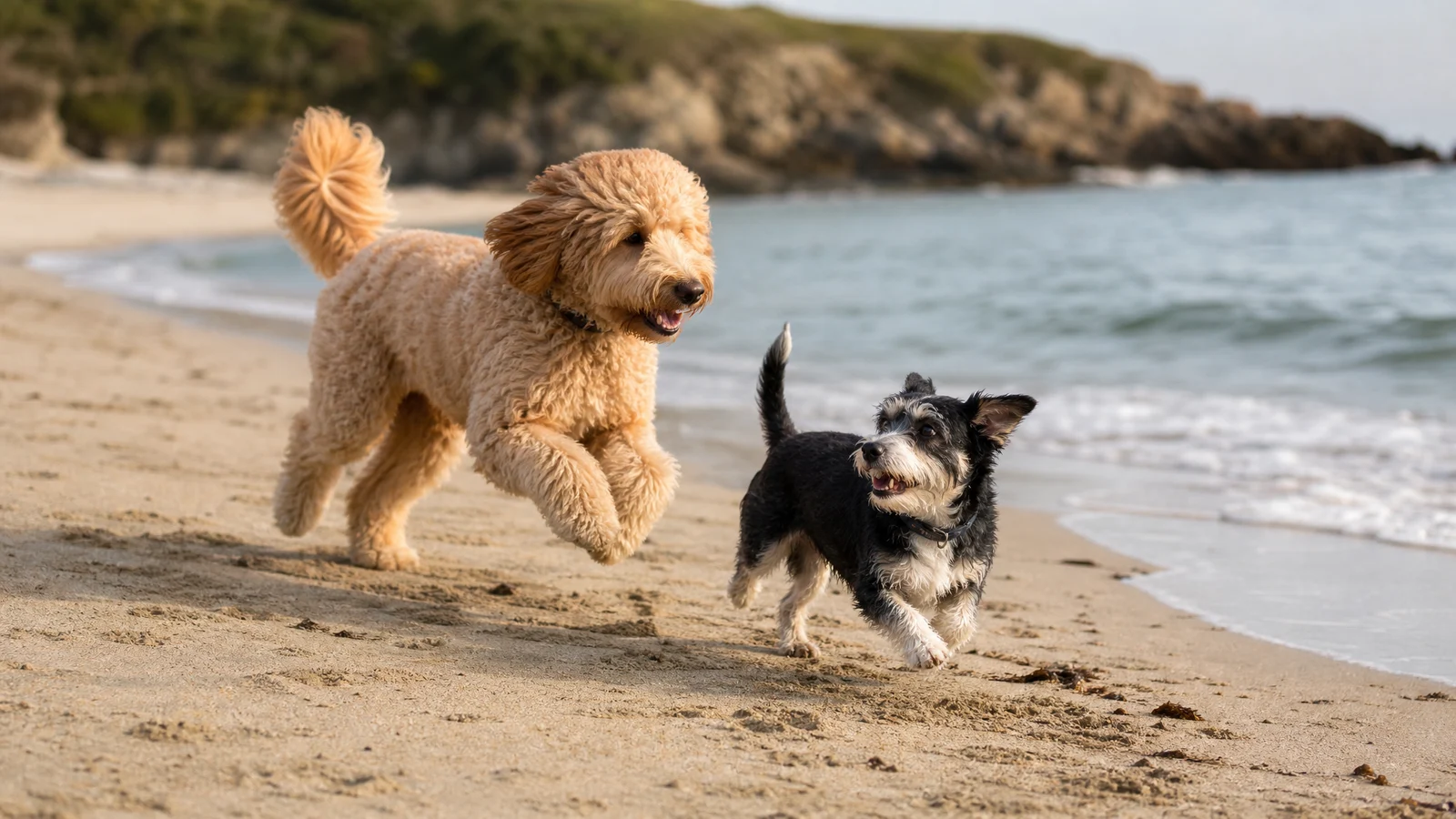
A chase across the yard does not tell you whether both dogs are enjoying the game. One may be inviting pursuit, or they may be trying to reach a place where it stops. The useful evidence comes from the exchanges around that run: who approaches, who pauses and whether a change of pace is respected.
Read the whole pattern before deciding your Goldendoodle is simply being friendly. A social reputation cannot establish how this particular pairing feels, and coat or body size can make quick signals harder to notice.
Below, we examine chase, wrestling and quieter shared activity, then teach a call-away that helps check your interpretation. The aim is to recognize when play remains mutual and when a different activity would serve the dogs better. You do not need to wait for an argument to justify a pause.
A Suitable Goldendoodle Play Pair
Begin with a known compatible dog in a secure setting where both handlers can supervise and separate comfortably. Similar energy can help, but it is not the only consideration. Size, age, movement style and ability to disengage all affect whether a game is manageable.
A small Goldendoodle and a larger dog may enjoy each other while still needing protection from accidental impacts. Two dogs of similar size can be poorly matched if one wants body contact and the other avoids it. Watch the interaction instead of treating the pairing as settled by appearance.
Remove food and toys that might create competition before unfamiliar play. Keep water accessible in a way that allows comfortable separate use. Make sure neither dog must squeeze past the other through a narrow entrance to leave the activity.
The ASPCA's body-language guidance emphasizes reading the whole dog in context. Tail movement alone is not a verdict. Look at posture, facial tension, speed and what happens when one participant changes direction or stops.
Agree with the other handler that either person can end the session. That agreement should not depend on assigning fault to either participant. A mismatched game can be unsuitable even when both dogs are otherwise comfortable social companions.
Chase Play With a Goldendoodle
Look before and after the fast movement. A dog who briefly runs away and then curves back with loose movement may be inviting another exchange. A dog who repeatedly heads for a gate, a person or a corner without returning may be trying to stop.
Changes in Direction and Pace
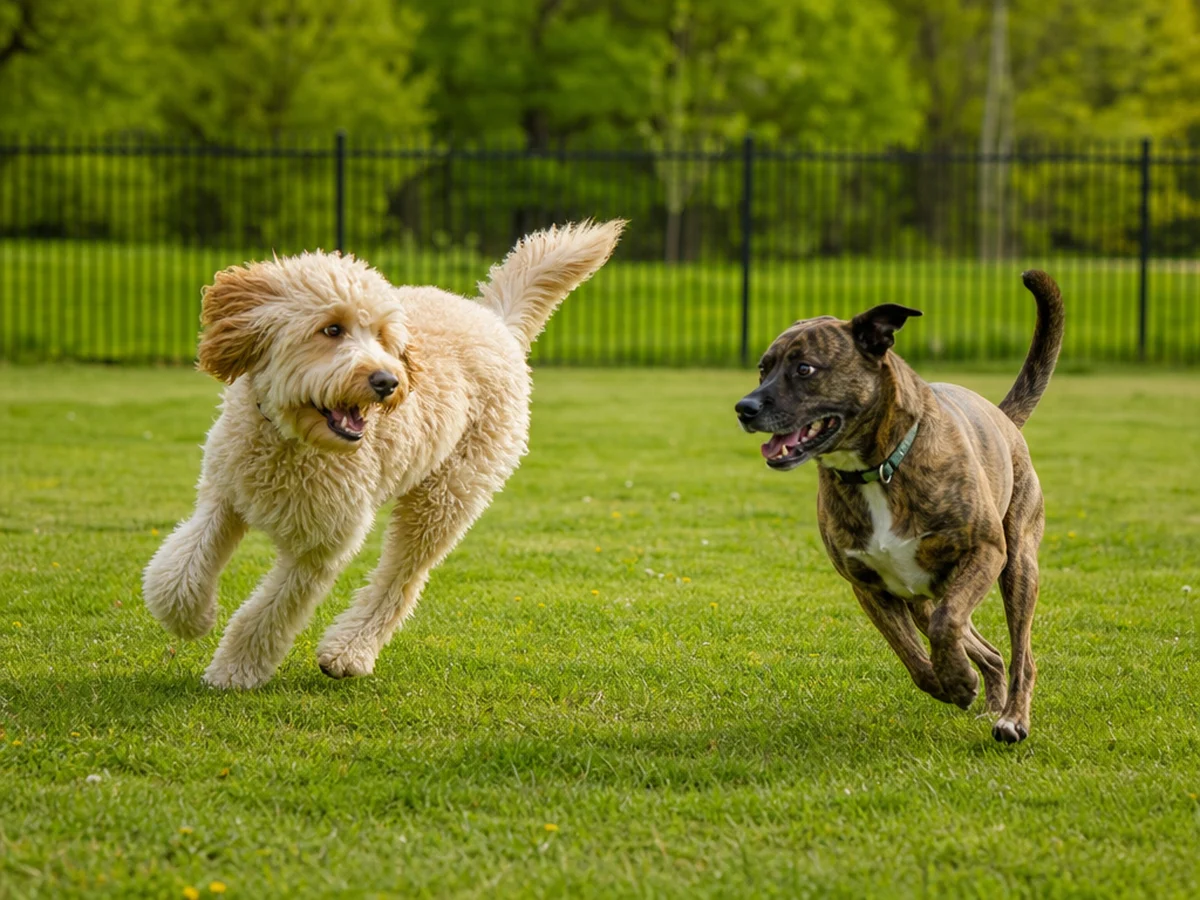
Notice whether both dogs can influence the route. Do they slow, turn and investigate something else without being immediately overwhelmed? Exact equality of chasing time is unnecessary, but repeated control by only one participant deserves closer attention.
A Goldendoodle who loves pursuit may keep moving after the partner wants to pause. Interrupt early and give both dogs room. The partner should not need to run harder, hide or deliver a stronger warning to obtain space.
Stay where you can see the far end of the run. A game that looks loose beside you can become uncomfortable when it reaches a fence or narrow gap. Secure space still needs a layout that lets dogs avoid being cornered.
The Dog Who Returns Voluntarily
After a natural separation, observe whether the other dog chooses to approach again. A relaxed return is useful evidence, though it does not guarantee that every later exchange will remain comfortable. Keep watching the pattern rather than treating one return as permission for unlimited chasing.
If the partner remains away, help your Goldendoodle choose another activity. Do not send them over repeatedly to renew the invitation. Quiet exploration nearby can be a good shared outing even when active chase has finished.
A pause is information. It does not promise another run.
Compare the approach before the chase with the approach after it. If the partner was loose and willing at first but now stays behind their person, the game has changed. Earlier enthusiasm does not override that new response, even when your Goldendoodle remains keen. Use the current interaction to decide what is suitable, rather than trying to recreate the best moment of the session.
Wrestling and Goldendoodle Play Contact
Close play needs particular attention because movement can become crowded quickly. Look for loose bodies, opportunities to change position and release from contact. A dog pinned, blocked or repeatedly knocked down without space to recover needs help ending the exchange.
Noise by itself does not identify comfortable or uncomfortable play. Some loose interactions are vocal, while a quiet dog may be tense. Read the sound alongside posture, movement and the other dog's response.
The professional discussion of polite play focuses on dogs responding to each other's requests. Apply that to body contact. When one participant turns away or tries to disengage, the useful response from the other is to allow room.
| Observed pattern | Handler decision |
|---|---|
| Loose contact with easy changes of position | Continue observing and allow natural pauses. |
| Repeated crowding when the partner moves away | Call the dogs apart and protect the break. |
| Stiffness, freezing or sustained avoidance | End the interaction and arrange more space. |
| A large impact or new movement difficulty | Stop play and assess whether veterinary advice is needed. |
Keep hands away from mouths and active wrestling. Plan your call-away and safe separation before play begins, rather than relying on grabbing collars in an escalating interaction. If you cannot interrupt safely, get professional guidance and avoid repeating that setting.
Fluffy coats can obscure small movements. Change your viewing angle when needed, without crowding the dogs, and ask the other handler what they see from their side. You need to observe whether the partner can leave, how quickly they choose to return and whether contact becomes looser after a pause. A happy-looking Goldendoodle supplies only part of that information.
Quiet Activity Between Play Exchanges
Sniffing the ground, standing near a handler or walking in parallel may be part of a comfortable social visit. Do not restart wrestling simply because the movement has slowed. Both dogs can gain something from sharing space without continuous physical contact.
Watch how the Goldendoodle responds when the partner investigates a scent. Respecting that activity is a social skill. Repeatedly nudging, blocking or climbing onto the other dog can turn a harmless pause into pressure.
Give each dog a clear resting option. For housemates, that may mean suitable gates or separate rooms when one needs uninterrupted rest. For visiting dogs, handlers can move apart and decide whether the shared session has already provided enough activity.
Our small-space activity ideas can provide an alternative after social play ends. Choose something the individual finds manageable, rather than adding another fast game automatically. A quieter transition may make the whole visit easier to finish.
Protect the break from people too. Children or visitors calling both dogs back together can erase the separation you just created. Explain that a dog choosing quiet time should be allowed to keep it.
A Goldendoodle Call-Away Before Exciting Play
Teach returning to the handler in a quiet setting before expecting it during a lively game. Choose a familiar cue and reward a willing approach. The dog should learn that moving toward you produces something worthwhile, rather than only predicting the end of enjoyable activity.
Return Without Another Dog Playing
Begin over a short distance in a safe enclosed area. Call when your Goldendoodle is available to respond, reward the arrival and then invite them back to a suitable activity. Do not keep repeating the cue while they are absorbed elsewhere.
The RSPCA's recall guidance cautions against using every return to end freedom. Keep practice varied and rewarding. Returning may sometimes lead to renewed activity, but safety and the other dog's comfort still determine whether play resumes.
- Reward an easy return in quiet space with no competing play.
- Practice near a calm partner far enough away to preserve an easy response to your cue.
- Choose a natural pause in a suitable interaction for the first call-away.
- Reward in separate space, then assess both dogs before changing the arrangement.
Use separate reward locations so dogs do not compete over the food. Each person should attend to their own dog. A successful return can be spoiled if both dogs immediately converge on one treat hand.
Return During an Early Natural Pause
Call before the game reaches its most intense point. If the dog can turn toward you, reward the movement into separate space. Keep the first attempts easy enough to watch the turn, approach and arrival clearly rather than urgently repeating their name.
If they cannot disengage, the practice level was too difficult. Arrange a calmer activity or greater separation next time. Avoid loose trailing lines during wrestling, where equipment can tangle around bodies or legs.
A dog who pulls toward every potential playmate may need separate walking practice. The adult Goldendoodle leash guide helps distinguish training space from situations that require a safer route. Social interest does not make every encounter suitable.
A Play Break Checks Your Interpretation
After the dogs separate, observe what each chooses. Your Goldendoodle may want to return immediately while the partner rests or stays near their handler. Give the quieter choice equal weight, and do not make persistence the deciding vote.
If both dogs become comfortable and seek renewed interaction, allow a brief opportunity only when both handlers agree. Watch the first exchange closely. Immediate return to the same crowding or one-sided pursuit suggests the pairing or activity needs changing.
Keep the separation calm. A pause should offer genuine relief from the game, with space to breathe, drink when appropriate and attend to ordinary surroundings. Holding two eager dogs nose to nose while demanding stillness is a different task and may increase frustration rather than clarify what either dog wants.
When uncertainty remains, end shared play. You can choose parallel activity on another day or consult a reward-based professional about the interaction. Another dog's stronger reaction should not be the tool used to teach your Goldendoodle social restraint.
The Next Goldendoodle Play Meeting
Record the pattern that worked: comfortable chase, brief wrestling, shared sniffing or simply calm proximity. Note what made a pause difficult, and mention new avoidance or movement concerns at regular veterinary visits. That information helps choose a suitable partner and setting next time.
A useful social session leaves both dogs able to influence the activity. Keep rewarding your Goldendoodle for returning, giving space and accepting a quieter alternative. Their enjoyment of other dogs becomes easier to support when the game does not depend on the other participant tolerating every invitation.
 Puppy trainingGoldendoodle Puppy at 8 to 12 Weeks: The First Month Home
 Puppy trainingGoldendoodle Puppy at 4 to 6 Months: What Changes
 Training basicsGoldendoodle Temperament: What It Means for Training
