 Goldendoodle
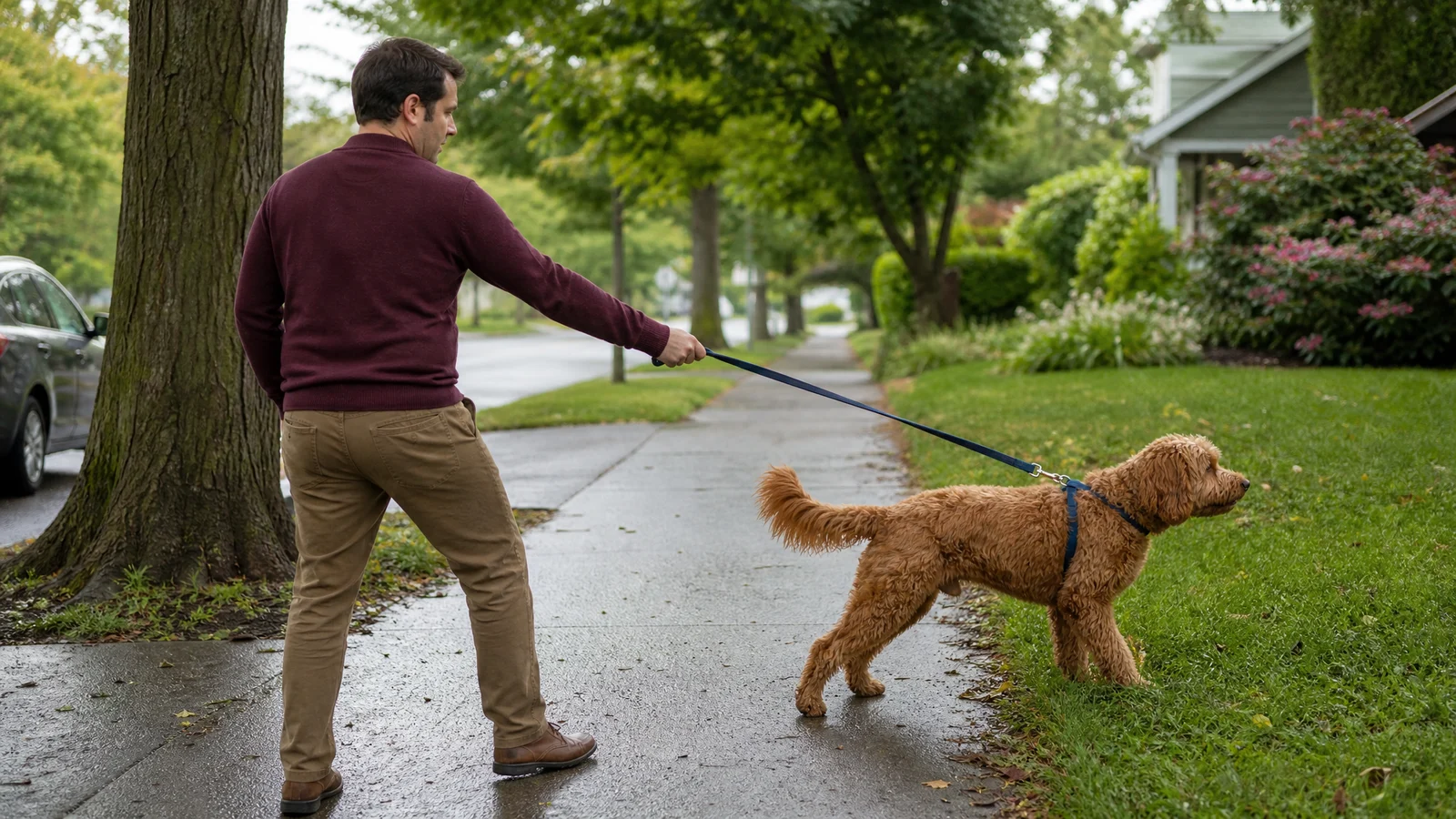
Whether your Goldendoodle is a Mini or a Standard changes what a pull costs you, but it never changes how the pull was learned. A tight line that has reached the mailbox, the neighbor's gate or a promising patch of grass a few times has taught your dog that leaning is worth the effort.
The good news is that a learned habit can be replaced. Goldendoodles often take well to a plan that pays them for the right thing, and slack is something you can start paying for today.
Read on for how pulling gets paid, the setup that makes practice easier, four stages that take you from hallway to sidewalk, and the snags that tend to turn up along the way.
A Tight Leash Pays More Often Than You Think
Pulling starts as a sensible bet. Your dog leans, the leash goes tight, and a few steps later the mailbox, the gate or the dog down the block is closer than it was. Each walk that ends at the thing your dog was leaning toward adds a little more proof that leaning works.
What surprises most owners is how little it takes to keep the habit alive. Even stopping four out of five times teaches a dog that pulling can still end in the reward of moving forward, so the one tug you let slide on a rushed morning is not free. Consistency is the whole engine here, and every stage below depends on it.
Goldendoodles add their own flavor. Both parent breeds are described as people-oriented, playful and eager to please, and a Goldendoodle may carry all of that straight down the leash toward every person, dog and smell in sight. That is why pulling in this cross often looks more like enthusiasm than stubbornness, and why the fix pays for the right kind of enthusiasm instead of trying to drain it.
Gear and Warm-Up for a Pulling Goldendoodle
A tight leash pays most when a walk begins at full excitement, so the first fix happens before you leave the house. Four things are worth having in hand before you start:
- A secure fit. Whatever your dog wears should sit snugly without pinching, and it is worth checking again with the coat in mind, since thick or curly fur can hide a strap that has slid out of place.
- Treats worth working for: small, soft pieces your dog can swallow without breaking stride, kept in a pocket or pouch so you can pay within a second of slack.
- A leash that stays one length gives the same feedback on every step, which an extendable leash cannot do, so use the plain kind for practice.
- Somewhere Dull to Begin: a hallway, a yard corner or a quiet room, anywhere nothing exciting is within sight.
Many owners also add a harness with a front clip, which is one way to manage pulling while the training catches up. Gear only manages the pull, though, and the four stages in the next section are what change it. None of this requires a perfect heel. The way we teach it, a relaxed walk needs only a leash that hangs in a loose curve while your dog sniffs, glances back and keeps moving with you, which is a far easier standard to teach and to keep up.
Play Before the Walk
Give your dog a few minutes of play first. A short game in the yard takes the edge off the first rush of energy, and a dog who has already let off steam can think, which is what the stages ask for. If the pulling began suddenly, or your dog seems sore or uneasy in their gear, mention it at regular vet visits before assuming the cause is only training.
A Four-Stage Leash Pulling Solution for Goldendoodles
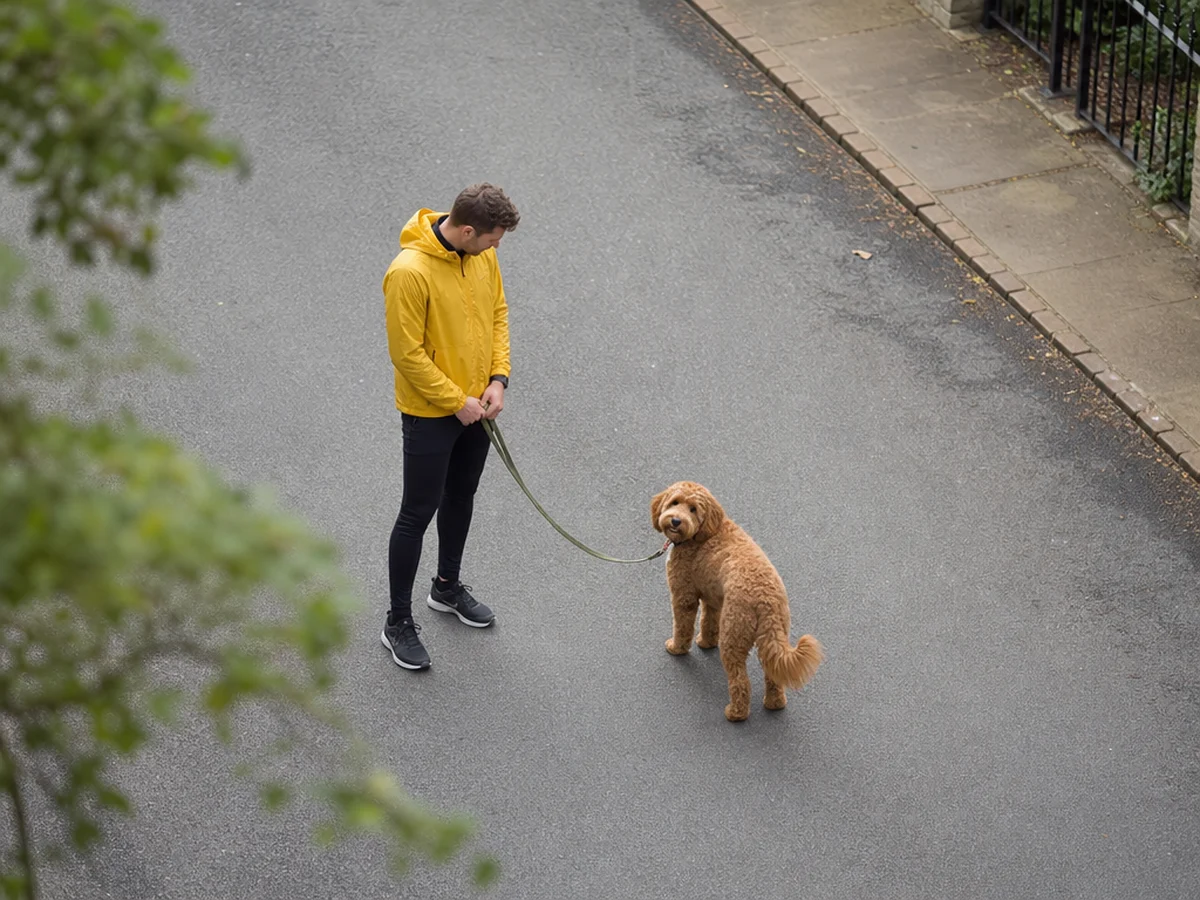
With the kit ready, the work comes in four stages, each slightly harder than the last. The only calendar worth using is the move-on test at the end of each stage: your dog does it smoothly several times in a row, and then you add the next difficulty. A Goldendoodle may breeze through the first stage and stall on the third, so give each stage the time it needs.
Leash Manners Start Indoors
Begin where nothing tempting is in sight, such as a hallway or a quiet room. This stage teaches the one position that will pay all day, which is slack beside you, and the steps are simple:
- Clip on the leash, hold it loosely against your body and take a step.
- The moment the leash hangs in a curve with your dog at or near your side, say a short marker word such as "yes".
- Drop a treat at your leg, so your dog has to be beside you to collect it.
- Step again and repeat, paying whenever the leash is loose and your dog is close.
Paying at your leg matters because the place where treats appear becomes the place your dog wants to be. If your dog drifts out ahead, shorten the gap between payments so slack is paid more often, and move on once staying beside you has become the easy choice.
Stop and Wait on the Move
Now add the rule that does most of the heavy lifting: the walk only moves forward while the leash is slack. When the line tightens, stop and stand still like a tree, then start again the moment it loosens. Dogs often take a step back toward you or glance around to see why the walk stopped, and that moment is what you are waiting for.
- The leash tightens, so you stop walking and keep your hands still, without pulling back.
- Wait quietly while your dog works out why the walk has stopped.
- When the line loosens, even slightly, say your marker word, pay at your leg and walk on.
- Do it every time, including on hurried days, because a tight leash that sometimes works is hard to unlearn.
You are the one who has to be dull and predictable here, because the exciting part, moving forward, is exactly what your dog is earning. If your dog simply leans into the stopped leash and nothing loosens, you have reached the end of what waiting can do alone, and the next stage is built for that moment.
Turn When Waiting Stalls
Some Goldendoodles will lean into a stopped leash for a long time, especially when something wonderful lies ahead. Rather than waiting longer, turn smoothly and walk the other way. Your dog is suddenly following instead of leading, and catching up to you is easy to pay for with a treat and a cheerful word.
Keep the turn gentle and the leash quiet, because the point is to change direction and not to tug your dog along. Once the turns work, mix in a few unexpected ones on every walk so your dog learns to keep an eye on where you are headed. When your dog begins to look back at you before the line ever tightens, you are ready for the sidewalk.
Add a Check-In Word Outside
Take everything outdoors one easy place at a time, starting with a quiet side street or the edge of your yard before moving to a busier block. Add a short check-in word, such as "look", and pay a glance back at you with a treat and a few steps of easy walking. Over time that glance becomes the first thing your dog does when something exciting appears.
Raise the difficulty by changing one thing at a time, such as a busier street or a distraction a little closer, and pay more often again whenever the difficulty jumps. As the leash stays loose for longer stretches, ask for slack over several steps before you pay. If a new place sends the pulling right back, ease the difficulty instead of repeating the rule louder.
Treats are the easiest pay to deliver, but they are not the only kind. Praise, a pat and a turn toward whatever your dog was leaning to reach can all pay for slack, and mixing them means your dog is still paid on the days you forgot the pouch.
Pulling Toward Dogs, People and Smells
Real walks put the temptations where you cannot move them, and both parent breeds are described as open to strangers, so a Goldendoodle may feel the tug of nearly every person and dog on the block. The stop-and-wait rule still applies, with a little planning around each kind of pull:
- Other dogs. Stop at the first sign of tension, add distance if you can, and ask for the check-in word before your dog is close. Pay the glance and allow a greeting only on a loose leash, so the hello itself becomes the reward. Our page on polite play with other dogs picks up from there.
- Greeting people works the same way: stop, wait for slack, and let the person approach only while the leash hangs loose, with the greeting as the pay. A dog who loves company may jump as well as pull, and polite greetings at the door covers that side of it.
In both cases you are not asking your dog to stop caring about the hello. You are making slack the way to get there.
Letting the Nose Lead
Smells are the third pull, and the one owners tend to fight hardest. A better deal is available. Teach your dog to walk nicely first, and then add a cue for exploring, such as "go sniff", that tells your dog the nose may lead. The leash still stays loose during exploring time, but the pace and the sniffing belong to your dog.
That trade works because the chance to sniff can be a great reward for walking well. Both parent breeds are described as needing mental work, and a nose-led stretch gives a busy mind real work to do. End exploring time with your check-in word and a glance back at you, and the walk carries on.
Pulling Practice That Fits Your Week
Knowing what to do around each temptation only helps if the practice actually happens, and practice goes best in small, frequent bursts. Plan on sessions of around 5 to 10 minutes at a time, since dogs learn best in short bursts, and finish on a good note while your dog is still doing well. That length slips easily between other chores, so there is little reason to wait for a free afternoon.
As slack becomes the habit, pay less often and less predictably, but keep paying the moments that matter, such as a loose leash past a favorite temptation. When the stops get shorter and the check-ins arrive sooner, you will know the habit is taking hold.
A dog who gets enough movement and mental work elsewhere arrives at the leash calmer, and our page on exercise and brain games has ideas. For longer routes, narrow paths and lunging, our guide to leash training a full-grown Goldendoodle goes further than this page does.
Mid-Walk Questions From Goldendoodle Owners
Three snags sit just outside the four stages: who else holds the leash, a dog who will not move and a pull that turns out to be more than a habit. Each gets a short answer below.
Can a dog walker follow this plan?
Yes, and it helps when they do. Give them the same simple rule you use, which is to stop when the leash tightens, move when it loosens and pay beside the leg. Share your marker word and your check-in word too, so your dog hears the same cues from everyone who holds the leash.
What if my Goldendoodle plants and will not move?
A dog who freezes may be unsure of the spot rather than being stubborn, so never drag them forward. Stand still with a loose leash, give them a moment, then step toward a quieter place and pay for any step in your direction. If the freezing is new or seems tied to discomfort, check in with your vet.
When is pulling more than a habit?
If the pulling comes with barking, lunging or a fixed stare at other dogs or people, you are likely dealing with a reaction rather than a pull. That needs distance and a plan of its own, ideally with a reward-based trainer who can watch your walks in person.
A Goldendoodle of Any Size Learns the Same Lesson
Size changes how much of this work happens in the setup. Goldendoodles vary from one dog to the next, and so does the force at the end of the leash. With a Mini a slipped step may cost you a sore wrist, while a Standard can cost you your footing, so on the strong dog's side of the line gear, balance and distance deserve extra thought.
Underneath, the lesson is the same at every size: a tight leash gets your dog nowhere, and a loose one gets them out the door, down the block and toward the people and smells that make the walk worth taking.
Loose-leash manners are one lesson among many for a Mini or a Standard, and the Goldendoodle e-book we put together lays out the rest, a copy of which is waiting for any reader who leaves an address on this site.
 Exercise and jobsHow to Teach a Goldendoodle to Shake and High Five
 Exercise and jobsHow to Teach a Goldendoodle to Spin
 Exercise and jobsHow to Teach a Goldendoodle to Roll Over
