 Goldendoodle
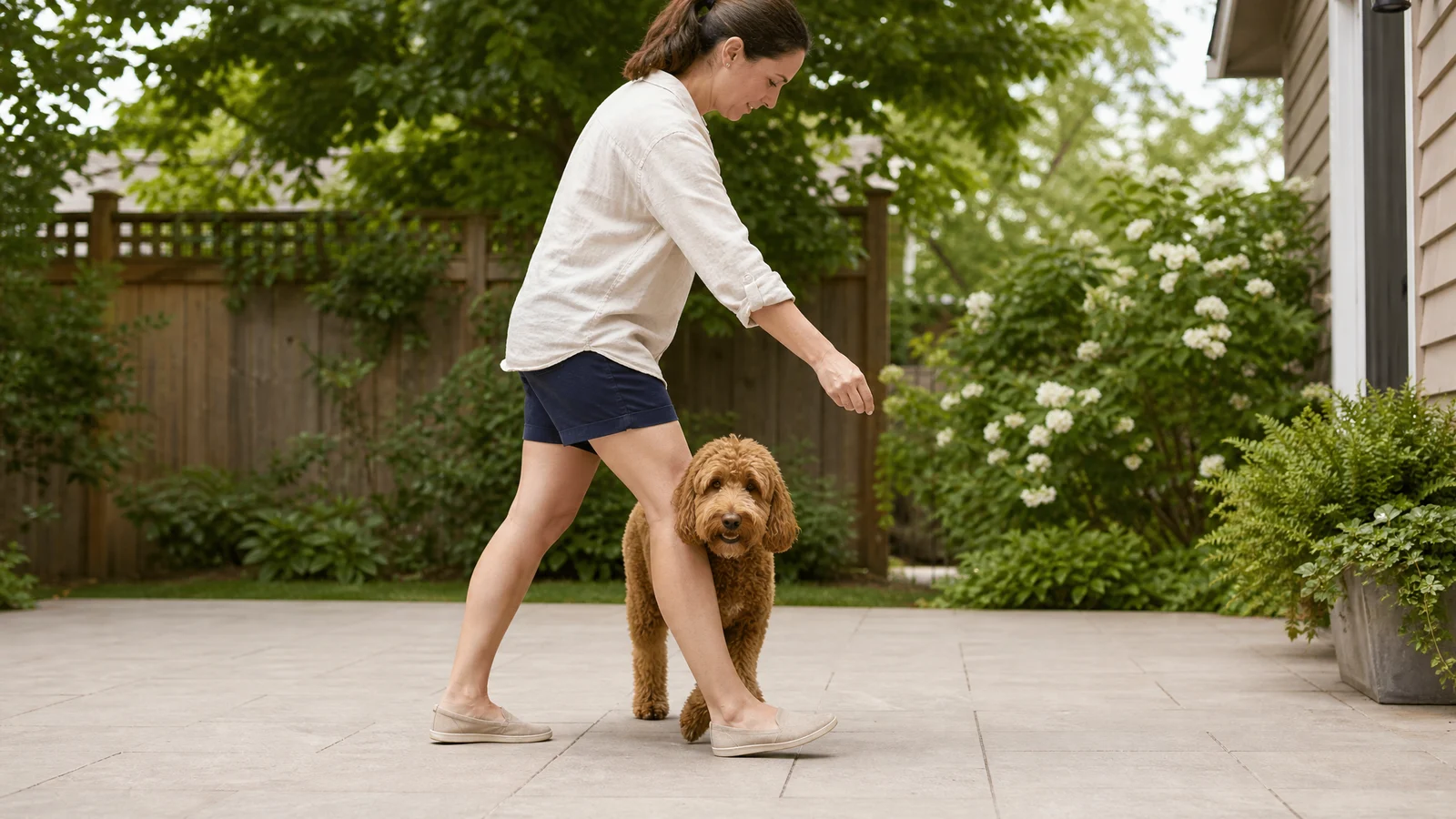
A Goldendoodle weaving between your legs looks like a small dance. Like any dance it is learned one step at a time long before it looks smooth.
The good news is that the trick needs no gear, only a few treats, a clear patch of floor and the patience to build it in layers. Below you will find every stage as its own short method: where to stand, how to lure a single pass, how to send your dog around each leg, how to join the sides into a figure eight, and how to trade the treat for an empty hand and a word. Each stage also says what to try when your dog stalls, so you can fix the spot that is giving trouble.
Floor, Stance and Size for a Goldendoodle Weave Trick
A dance needs a floor, and this one needs a patch with good grip, because your dog will be turning tightly beside your shins. Clear the space on the far side of your legs as well, so each pass ends with room to collect the treat rather than a toy or a chair in the way.
Size is the next thing to read honestly. Goldendoodles can be bred from Poodles of different sizes, so your dog might be a compact mini who slips through with room to spare or a big dog who nearly fills the gap. Neither is a problem, but a bigger dog needs a wider stance and a slower treat hand, and a smaller one may need you to bend lower so the treat stays at nose height.
Then settle your own stance. Stand with your feet a little wider than your hips, soften your knees and keep the treat hand low and relaxed.
You will hold this position through every stage that follows, so choose one you can keep comfortably without wobbling. Keep up your regular vet visits as well, and ask your vet before starting if your dog has ever seemed reluctant to turn or bend.
Teaching the Weave One Leg at a Time
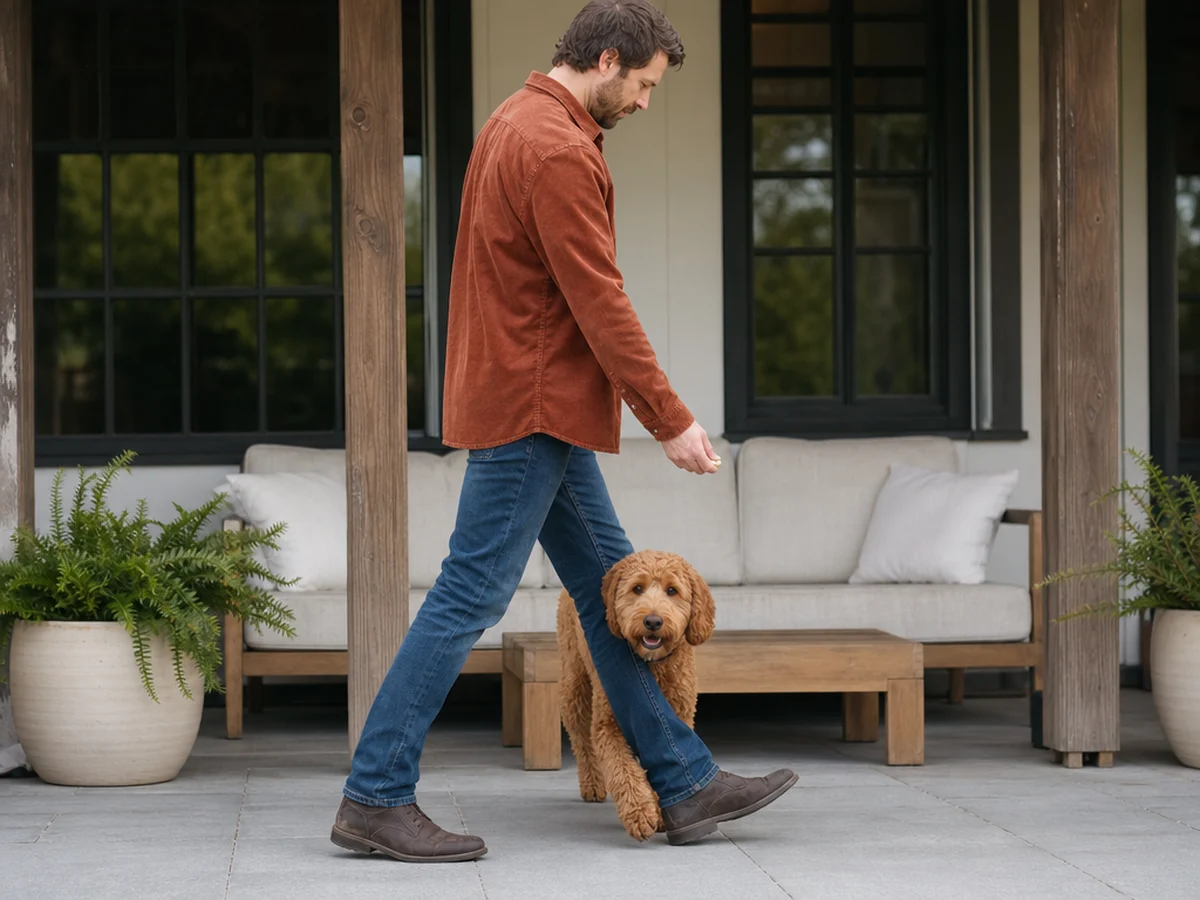
With the room and your stance sorted, the weave breaks into three small lessons: a single pass through the gap, a loop around one leg, and the same loop around the other. The order follows AKC's leg weave method, which holds the treat behind your legs to lure your dog through and around instead of pushing the food at them from the front.
A Single Pass Through the Gap
Take the leash off, stand with your feet wide and let your Goldendoodle wait in front of you. Keep the treats tiny and soft so every pass is paid quickly, then work through these steps:
- Hold a treat in one hand behind your legs, so your dog has to travel through the gap to reach it.
- Bend your knees a little and draw the treat hand back slowly, keeping it low so your dog's nose follows it between your legs.
- The moment your dog has passed between your legs, say your marker word or click, then pay with the treat.
- Lure or call your dog back to the front, reset your hand behind your legs and repeat.
Stay on this stage until your dog walks through smoothly several times in a row without pausing to study the gap, because every later stage is built on this one pass. If your Goldendoodle stops short, widen your stance or pay for the first step toward the gap, then ask for a little more each time.
Around One Leg and Back to You
Once the pass is easy, ask for more of the same path and finish where you began, with your dog back in front of you. Let the loop grow only as fast as the pass stays smooth, and use this order:
- Lure through the gap as before, but keep the treat hand moving around one leg, say your right, so your dog circles that leg.
- Let your dog lick and nibble at the treat as they go, which can help keep them close and moving along the path.
- Lead them around until they come back to stand in front of you, then mark, praise and pay.
- Reset and repeat until the loop flows without hesitation.
If your dog cuts across or backs out partway, shorten the loop: pay at the far side of the leg first, then at the halfway point, then at the finish. Each small win teaches the path in a smaller piece, so the full circle stops feeling like one big ask.
The Other Leg
Switch sides only when the first loop is easy. Run the same steps around your left leg, and expect it to feel like starting over for a little while, because your dog now has to follow your hand in the opposite direction. Pay for the pass through the gap first, then for the first half of the loop, and build back up to the full circle.
Stitching Two Loops Into a Goldendoodle Figure 8
When each side is easy and your dog follows the treat smoothly on both, the figure eight is simply the two loops joined, and the only new rule is that the treat waits until the end. Run the join in this order:
- Lure through the gap and around your right leg, exactly as before, but do not pay when your dog comes back to your front.
- Without stopping, send them through the gap again and around your left leg.
- Mark, praise and pay once your dog has finished both loops and returned to stand in front of you.
If your Goldendoodle slows down or drifts off between the loops, pay one loop earlier and link them again a little later, because the join is the new skill and a dog who can do each side alone has not forgotten anything. A larger dog may also need a wider stance here, since the turn between loops can be where the gap feels tightest.
Weaning the Weave Off the Treat
Right now your Goldendoodle is following food, not a pattern, so the next stages hand the job over to your body in small trades. We keep each trade small and pay generously for the first few passes of every new version, because a dog who is paid well for a change is happy to try the next one.
Swapping Food for an Empty Hand
Hold the treat in your other hand or tuck it where your dog cannot reach it, then trace the same figure eight with an empty guiding hand. When your dog completes both loops following that hand, pay from the other hand. If they hesitate or stop following, bring the treat back into the guiding hand for a few passes and try again, since the lure can return whenever the new version gets too hard.
Naming It and Letting the Hand Shrink
Once your dog follows the empty hand through the whole figure eight, add a word such as weave or legs just before the hand starts to move, and say it once rather than repeating it. With more repetitions, shrink the hand movement until it becomes a small signal, and your dog will begin to read your bending knees as the cue. Because the knee bend is now part of the trick, keep it at the same speed each time so it always means the same thing.
Weaving on the Move, an Advanced Goldendoodle Trick
A weave that holds while you stand still is ready for walking. Start by taking large, slow steps as you ask for each pass, and bring the treat lure back into your guiding hand while your dog works out the new rhythm. As your dog gains experience, phase the lure out again and walk faster with smaller steps to polish the trick. When you want another trick to build, the Goldendoodle puppy tricks guide lays out more of them.
Odd Moments in Weave Practice
Short sessions, a dog who gets carried away and a jump at the knee bend are three spots where practice can turn sticky, so each gets a direct answer here. None of them changes the method above, only how you apply it on a given day.
How long should a weave session last?
Keep it short. AAHA's training tips suggest spending a few minutes each day on behaviors your dog already knows or on new challenges, and one stage of the weave fits that kind of routine well. Stop after a few clean passes while your Goldendoodle is still keen, and pick up at the same stage next time.
What if my Goldendoodle gets too wound up?
Pause, and let the excitement settle before you ask for another pass. A Goldendoodle can carry a playful, puppyish streak into adulthood, and from what we see that bounce can crowd out the careful following this trick needs.
Go back to an easier stage, use smaller treats and a slower hand, and make sure the day's exercise has happened first. Our Goldendoodle exercise guide covers ways to spend that energy.
Why does my dog leap at my knee bend?
To a playful dog, a sudden bend can look like an invitation to leap rather than the start of a weave. Bend slowly and low, keep the treat hand below chest height, and pay only when all four paws are on the floor, so the bend comes to mean a calm pass.
Keeping the Weave Away From Leash Walks
Once the weave works it is tempting to try it everywhere, but a leash looped around your ankles has no place in this trick. Practice in the living room, a hallway or a fenced yard with the leash off, and let walks stay walks, with their own rules and their own rewards.
That boundary keeps the weave what it is meant to be, a short indoor game with a clear start, a clear finish and a treat in between, so your dog knows exactly what is being asked. With the weave working, the everyday lessons are still waiting, and our free Goldendoodle e-book covers every one of them in depth while staying easy to read.
 Exercise and jobsHow to Teach a Goldendoodle to Jump Over Obstacles
 Training basicsAre Goldendoodles Easy to Train? Smart or Stubborn
 Training basicsAre Goldendoodles Good With Kids?
